

Executive Summary
"AI-powered" has become table stakes in loyalty marketing, yet few platforms can say what data the AI accesses at decision time, what decisions it makes, where it executes them, and how its financial impact is isolated. Fragmented data, decisioning, channels, and measurement create margin leakage. Composable connection turns those same components into a real-time operating loop, and a closed loop is what makes incremental margin and loyalty program ROI attributable instead of asserted. This article walks through the architecture behind a genuinely AI-driven loyalty platform and what buyers should demand before believing any "connects everything" claim.
Almost every loyalty vendor now claims to be AI-powered. Very few can answer four basic questions. What data can the AI actually access at decision time? What decisions does it make? Where does it execute those decisions? And how is its financial impact isolated from everything else that touches revenue?
Those questions matter because loyalty is no longer a rewards application that sits off to the side. Done right, it is connected decision and measurement infrastructure. It watches signals across the business, decides who should get what, executes through every channel, and proves what that intervention actually caused.
Exchange Solutions™ built and hardened this approach to the AI-driven loyalty platform in fuel and convenience retail, one of the most demanding environments in loyalty: high-frequency transactions, thin and volatile margins, and customers who expect to earn and redeem instantly at the pump, in the store, and in the app. That track record is proof of performance under pressure, not a boundary. The same platform discipline extends across enterprise retail, ecommerce, pharmacy, B2B, and other complex ecosystems. You can see the results in loyalty ROI in fuel and convenience.
Loyalty fragmentation is a margin problem, not just a CX problem
Disconnected loyalty systems are usually framed as a customer experience issue. Inconsistent offers. Clunky redemptions. That framing understates the damage. Fragmentation is a direct and measurable margin problem.
Where disconnected loyalty systems leak enterprise margin
When CRM, POS, ecommerce, loyalty, promotion, and analytics systems each make decisions separately, costs hide in the gaps between them. The most common leaks look like this: blanket incentives delivered to customers who were already going to buy. Stale segments that miss live intent, inventory conditions, churn signals, or customer context. Duplicate or conflicting channel-specific offers that train customers to wait for discounts. Slow campaign execution stuck behind analyst queues, developer dependencies, and vendor service tickets. Vendor-funded promotional budgets that go unused or unattributed. Rewards credited with revenue they merely touched rather than caused. And hours of manual reconciliation between campaign reports, loyalty ledgers, finance systems, and channel analytics.
None of these show up as a line item called "fragmentation." They show up as discount spend that didn't change behavior, and as ROI reports nobody in finance trusts.
Why a disconnected stack makes "AI-powered" claims difficult to trust
AI claims are only as credible as the connections underneath them. Before accepting any vendor's AI story, ask: What information can the model access at decision time? Is that data real time, near real time, or an overnight batch? Can the AI execute through every relevant channel, or does it only recommend actions inside a dashboard? Does the outcome flow back into the same system for learning and measurement? Can your team inspect decision logic, constraints, confidence, and financial assumptions? And what does the AI actually optimize: engagement, conversion, gross revenue, incremental margin, or an undefined composite score?
A model trapped behind stale data and manual export steps is not an AI-driven platform. It is a reporting tool with a prediction feature.
The five connections an AI-driven loyalty platform must maintain
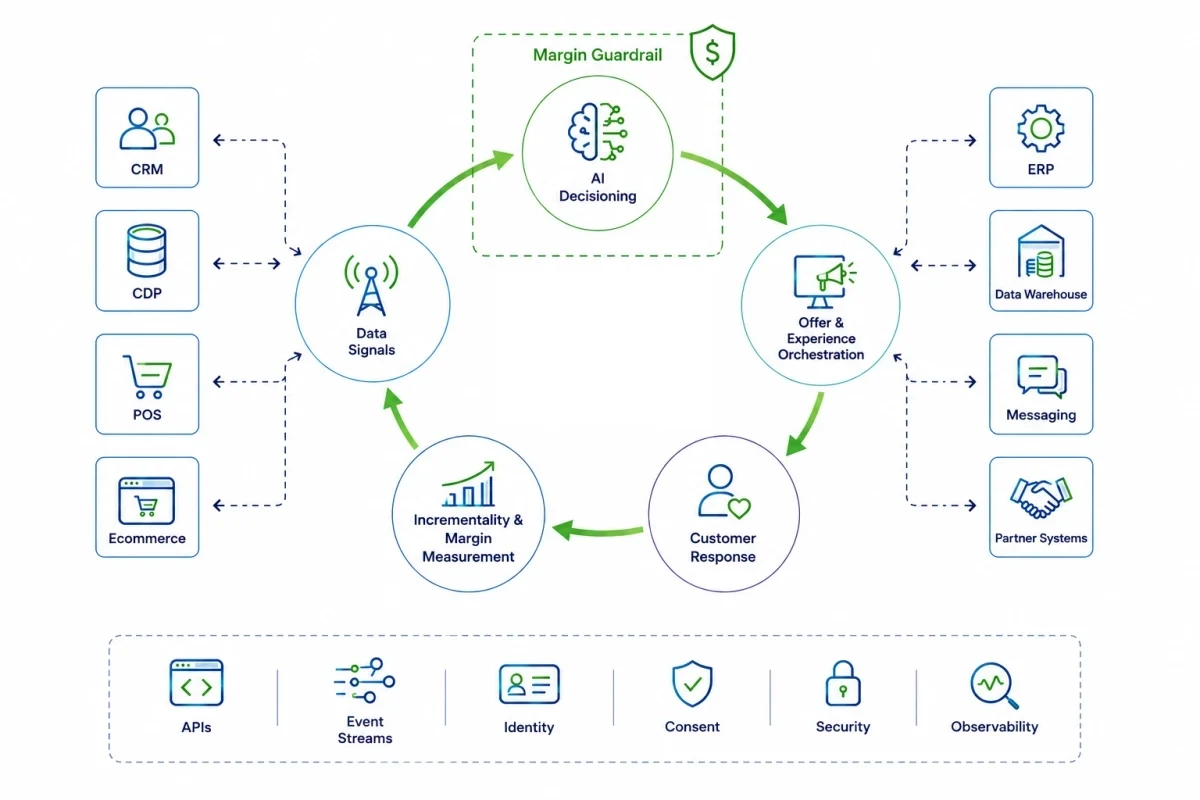
A genuinely connected platform maintains five live connections at once: customer and account data; behavioral and transactional signals; audience, offer, and next-best-action decisioning; store, web, app, email, partner, and service channels; and test, control, profitability, and attribution data.
Connection is not a one-time integration project. It is a continuous operating capability that has to survive stack changes, new channels, and new data sources.
Use a fragmentation diagnostic to find the sources of margin leakage
You cannot fix leakage you have not located. The fastest way to find it is a structured diagnostic that maps each fragmentation signal to its likely margin cost, the platform connection that repairs it, and the KPI that proves the repair worked.
Fragmentation-to-margin-recovery diagnostic
| Fragmentation signal | Likely margin leakage | Required platform connection | Evidence and KPI |
|---|---|---|---|
| Customer data split across CRM, CDP, POS, ecommerce, and loyalty records | Stale eligibility, duplicate profiles, irrelevant treatment | API and event ingestion feeding a shared decision context | Signal latency, identity match rate, profile availability |
| Campaigns depend on manual segmentation and offer setup | Slow launches, broad discounts, rising operating cost | AI-assisted audience creation, offer decisioning, automated execution | Time to launch, campaigns per operator, incremental margin per offer |
| Store, web, app, and messaging channels use separate rules | Conflicting offers, inconsistent balances, channel cannibalization | Omnichannel loyalty orchestration with shared offer and member state | Cross-channel consistency, redemption accuracy, response latency |
| Loyalty ledger, offer engine, and experience layer are tightly coupled | Risky releases, long change cycles, expensive customization | Composable services and headless experience delivery | Deployment frequency, integration lead time, change-failure rate |
| Vendor-funded offers sit outside the loyalty measurement process | Underused funds, weak partner reporting, unproven lift | Funding, targeting, fulfillment, and attribution in one workflow | Budget utilization, partner-funded incremental margin, offer efficiency |
| Reporting relies on last-touch or exposed-customer revenue | Overstated ROI and continued funding of nonincremental behavior | Holdouts, test-versus-control analysis, cost and margin feeds | Causal lift, net incremental margin, program ROI, payback period |
Turn the diagnostic into a cross-functional scorecard
Score each row from 0 to 2. A 0 means disconnected or mostly manual. A 1 means partially integrated or batch-based. A 2 means real-time, observable, and measurable.
Ask CRM, IT, digital experience, data, and finance leaders to score independently before comparing answers. Major disagreements are themselves a finding: they usually signal poor observability or unclear system ownership. Flag any row where no one can name a system owner, a data source, an SLA, and a financial KPI.
Then use the lowest-scoring connection to pick your first composable deployment. Fix the biggest leak first. Do not begin with a wholesale replatform.
Separate symptoms from architectural causes
Symptoms mislead when read in isolation. Low redemption may be an offer relevance problem, a channel delivery problem, or an eligibility latency problem. High engagement with weak profit often signals over-incentivization, not loyalty success. Long campaign cycles may originate in data access, approval workflows, or tightly coupled deployment processes. Inconsistent ROI reports usually trace back to disconnected cost, margin, and control-group data.
This is why adding another dashboard never fixes the problem. A dashboard displays the outputs of a broken operating loop. It does not repair the loop.
The real-time loyalty loop connects signals, decisions, actions, and proof
So what does a working loop look like? An AI-driven loyalty platform runs a continuous five-stage cycle: signal, decide, deliver, observe, learn.
How the connected loyalty loop operates
Signal.
The platform ingests purchases, browsing, app behavior, location, loyalty state, product affinity, inventory, margin, vendor funding, service activity, and account behavior. It works across identified and anonymous contexts where consent permits.
Decide.
For each customer and moment, the platform determines eligibility, propensity and predicted response, churn or growth opportunity, the strategic behavior to encourage, the minimum effective incentive, and the budget, margin, inventory, and brand constraints that apply.
Deliver.
Decisions execute through POS, ecommerce, mobile app, email, SMS, paid media, customer service, partner portals, or B2B ordering systems, whichever channel fits the moment.
Observe.
Exposure, activation, redemption, purchase, basket change, channel movement, and post-offer behavior all flow back into the platform.
Learn.
The platform compares treated customers with a control group, updates models and audience logic, reallocates promotional budget, and improves the next decision.
Why connection must come before scalable AI
Each break in the loop caps what AI can do. AI cannot make a current decision from inaccessible or stale signals. A prediction trapped inside an analytics tool creates no value until another system can execute it. Channel execution without return data means the platform never learns what happened. Revenue reporting without control groups teaches the system to favor correlation over causation. And disconnected financial data can make a high-redemption offer look successful while it quietly destroys contribution margin.
Real-time AI personalization in loyalty depends on two things at once: low-latency execution and a measurable feedback path. Miss either one and "real time" becomes a marketing adjective.
Composable and headless architecture make the AI loop deployable
The loop is the operating model. Composable and headless architecture is what makes it deployable inside a real enterprise stack, without a rip-and-replace project.
What composable, headless, and MACH mean in loyalty architecture
Headless loyalty platform architecture separates loyalty logic from the customer-facing experience. Web, app, store, partner, and emerging interfaces all consume the same capabilities without duplicating core logic.
A composable loyalty platform delivers independently deployable capabilities: member management, offer decisioning, rewards, promotions, analytics, and engagement. You can replace or enhance one layer without destabilizing the complete loyalty stack.
API-first means documented contracts for activating capabilities from external systems, with versioning, testing, portability, and automation treated as product requirements. The OpenAPI Specification is the reference standard for what documented, language-agnostic API contracts should look like.
Cloud-native delivers independent scaling, elastic capacity, resilience, monitoring, and deployment automation.
MACH validation matters because these words are easy to claim. A MACH-certified loyalty platform has had its architecture independently reviewed against the Alliance's standards. Exchange Solutions is a certified MACH Alliance ISV, detailed in its MACH-certified composable architecture. The historical acronym stood for microservices, API-first, cloud-native, and headless. The MACH Alliance principles now emphasize open, composable, and connected enterprise architecture, which is exactly the standard an AI loyalty loop requires. For a deeper primer, see the MACH architecture glossary entry.
Loyalty platform API integration without rip-and-replace
Can an enterprise add AI loyalty capabilities without replacing its existing stack? Yes, if the architecture respects existing systems of record. Start by deciding which systems remain authoritative for customer identity, transactions, content, consent, inventory, and finance. Then let the loyalty or offer module operate as an overlay rather than a replacement.
Practically, that requires synchronous APIs for immediate decisions and asynchronous events for behavioral updates, with the CloudEvents specification serving as the CNCF-backed standard for interoperable event data across services. It requires documented webhooks, data contracts, authentication methods, retries, idempotency, and error handling. It should preserve batch options for legacy systems without making batch the architectural default. And it must protect your ability to change a CRM, ecommerce platform, ESP, or data warehouse independently.
Exchange Solutions positions its products as independently deployable components designed to integrate into existing enterprise ecosystems, with 50+ technology integration partners across CRM, POS, data platform, ecommerce, payment, and martech.
Technical evidence buyers should request before accepting "composable"
Words are cheap. Ask for artifacts: public or buyer-accessible API documentation; a sandbox or test environment; an API versioning and deprecation policy; webhook and event documentation; data export and portability procedures; reference architectures for CRM, POS, CDP, ERP, ecommerce, and warehouse integration; latency and uptime commitments by use case; graceful degradation and offline behavior; observability including logs, traces, error reporting, decision histories, and audit trails; and evidence of independent deployment rather than a catalog of modules that all share one release cycle.
How composability changes the financial case
Composability is a financial strategy, not just an engineering preference. It lets you stage implementation around the highest-margin leakage point and prove value before expanding scope. You avoid paying for unused suite capabilities. You reduce the cost and risk of future stack changes. You scale high-volume services without scaling every platform component. Compare total cost of change over three to five years, not just initial license and implementation cost. And treat exit cost and data portability as enterprise value protection.
AI turns the connected loop into campaign and offer execution
Architecture becomes real when someone runs a campaign on it. This is where the AI layer earns its keep.
What AI-driven campaign execution should automate
An AI execution layer should translate a business objective into a measurable target behavior. It should discover audiences from plain-language or self-service prompts. It should score customers by propensity, value, churn risk, or growth opportunity. It should determine whether an incentive is even required, and select an offer based on relevance, profitability, budget, and strategic constraints. It should activate the decision through existing campaign and channel systems, monitor anomalies, utilization, lift, and budget consumption, and recommend adjustments, all while preserving marketer approvals and financial guardrails.
Exchange Solutions' AI takes this shape as specialized AI agents built for loyalty execution (Analytics, Audience, Offer, Support, and Insights agents) rather than a single generic AI assistant bolted onto a dashboard.
Product spotlight: ES Loyalty Boost
AI-powered offer automation is the execution layer that makes the architecture tangible. ES Loyalty Boost™ connects audience discovery, campaign development, individualized targeting, dynamic offer selection, automated deployment, and performance insights into one workflow. Because it is composable, ES Loyalty Boost can operate alongside ES Loyalty™ or plug into an existing loyalty platform: enhancement first, replacement only if warranted.
Every capability maps back to one of three outcomes: less manual campaign work, less unnecessary incentive spend, or more incremental customer behavior. If a feature cannot be traced to one of those three, it is decoration.
Current published proof points include 2x targeted-offer completion, 12% sales growth on promoted items, 14% lower offer costs, and 50% greater operational efficiency. Treat numbers like these the right way: ask for the methodology, client context, time period, and denominator behind each one. A credible vendor volunteers that detail.
See what AI looks like when it can act
Explore how Exchange Solutions' ES Loyalty Boost capabilities connect audience intelligence, campaign execution, and dynamic offer automation inside an existing loyalty ecosystem, through Our AI Story and ES Loyalty Boost. Explore the AI agent ecosystem and see how individualized offers can be added without rebuilding your loyalty stack.
Omnichannel loyalty orchestration means one decision system across every channel
How does omnichannel loyalty orchestration work in real time? One decision policy, many execution endpoints. Not seven channel teams running seven rule sets.
What omnichannel loyalty orchestration actually connects
Orchestration means shared member, account, reward, eligibility, and offer state across the business. Decision rules stay consistent across stores, ecommerce, apps, messaging, service, and partner channels. Presentation can vary by channel; economics cannot. Earn, redeem, activate, expire, and reverse events all return to the same operating record. Journeys can begin anonymously and continue after identification. Offers follow a customer without being duplicated or applied twice. The pattern is a central decision policy with distributed execution endpoints.
Where real-time AI personalization creates measurable value
Real-time decisioning earns its cost in specific moments: live ecommerce sessions and cart abandonment; basket-stretch opportunities before checkout; store transactions where immediate eligibility and redemption matter; churn or lapse signals that need timely intervention; category expansion and replenishment moments; inventory, fulfillment, or demand-shaping use cases; and B2B account growth, product adoption, reorder frequency, and rebate optimization.
ES Engage™ is a working example of the pattern: it detects live purchase intent in-session, balances conversion against margin, and executes an offer before the customer leaves.
The engineering requirements behind "real time"
"Real time" should be an engineering commitment, not an adjective. Define latency expectations for each interaction type. Distinguish model-processing time from complete signal-to-experience latency. Address event ordering, duplicate events, retries, reversals, and idempotent redemption. Be explicit about which data requires strong consistency and where eventual consistency is acceptable. Maintain fallbacks when a model, API, channel, or external system is unavailable. Preserve offer and balance accuracy during store connectivity issues and seasonal peaks. And document identity stitching and consent rules as customers move between anonymous and identified states.
Measure the whole journey, not a channel slice
Channel-siloed measurement double-counts wins and hides losses. Track cross-channel redemption, movement from digital research to store purchase, store-to-digital retention, channel cannibalization, timing displacement, product and category halo effects, and fulfillment and return economics. The number that matters is net incremental margin across the journey. Never award every participating channel full credit for the same outcome.
Loyalty program ROI attribution requires incrementality, not more dashboards
How should a loyalty platform prove incremental ROI? By measuring what the program caused, not what it touched. That distinction is where most loyalty ROI reporting fails.
Attribution answers what touched revenue; incrementality asks what caused it
Member revenue is not automatically loyalty-generated revenue. High-intent customers redeem offers without changing their behavior at all: they were buying anyway. Academic research backs this up: the Journal of Marketing's long-term loyalty program study found loyalty effects vary sharply by prior customer behavior, and Journal of Service Research work on enrollments and profit examines whether enrollment produces profitable change rather than merely correlated activity.
So keep six numbers distinct: exposed revenue, redeemed revenue, attributed revenue, incremental revenue, incremental gross margin, and net incremental margin. Only the last three tell you what the program earned. That is loyalty incrementality: the change in behavior that would not have happened without the program. Use holdout or control populations to estimate the counterfactual, and account for seasonality, selection bias, timing shifts, cannibalization, returns, and channel displacement. Exchange Solutions defines incremental margin measurement through test-versus-control methodology and treats it as the foundation of defensible loyalty ROI.
Value Exchange Optimization closes the financial feedback loop
Value Exchange Optimization is the discipline that turns measurement into an operating policy. Identify the customer behavior with economic value. Estimate whether that behavior would happen without intervention. Predict the smallest incentive likely to change it. Apply customer relevance, brand, inventory, budget, and margin constraints. Execute through the right channel. Compare the treated population with a valid control. Calculate incremental margin after reward, platform, and operating costs. Reallocate budget toward offers, customers, and behaviors that produce profitable lift. And suppress offers where expected incremental value does not justify the cost.
The point: ROI is continuously proven inside the loop, not reconstructed by a reporting layer after execution.
Give finance buyers an auditable ROI model
Finance should be able to rebuild the math. The model is: incremental revenue is test-group revenue minus expected control-group revenue, scaled to the treated population. Incremental gross margin adjusts that for product or category margin. Net incremental margin subtracts rewards, incentives, media, platform, services, and operating costs. Program ROI is net incremental margin divided by total program cost. Payback period is the time for cumulative net incremental margin to cover implementation and operating investment.
Separate brand-funded and vendor-funded economics from retailer-funded incentives. Show sensitivity ranges for margin assumptions, response rates, incentive cost, and adoption. And insist on exportable calculations rather than a vendor-controlled summary score.
What a credible platform proof package contains
Ask any vendor for the full package: predefined hypotheses and success metrics, test and control construction, sample size and test duration, statistical confidence or uncertainty range, baseline-period behavior, all incentive, reward, platform, and operating costs, the margin source and calculation method, treatment contamination checks, cannibalization and displacement analysis, offer-level and program-level results, reproducible data exports and decision audit trails, and an honest explanation of underperforming tests, not just selected success stories.
Fuel and convenience results are an architectural stress test
Fuel and convenience retail combines high transaction frequency, thin and volatile margins, store and digital coordination, immediate earn-and-redeem expectations, and complex product, partner, and funded-offer economics. A decision and measurement loop that holds up there has been stress-tested in conditions most industries never reach. The right question for an enterprise buyer is not "is my industry different?" It is: can the same decision, integration, and measurement loop be configured for my categories and systems? See the platform applied by industry.
Buyer checklist for a platform that claims to connect everything
Use this checklist in RFPs and vendor evaluations. Every question has a verifiable answer. Vague responses are answers too.
Architecture and composability questions
- Can loyalty, offers, analytics, engagement, and rewards be deployed independently?
- Does replacing one capability require a broader platform release?
- Which systems remain the customer, transaction, balance, consent, and financial sources of truth?
- Are APIs documented, versioned, tested, and observable?
- Does the platform support synchronous APIs, asynchronous events, and legacy batch patterns?
- Can we export customer, transaction, offer, decision, and performance data?
- What changes can internal teams make without custom development or vendor services?
- What evidence supports the vendor's MACH or composability claims?
- Can individual services scale independently?
- What is the exit plan if a module is replaced?
AI and decisioning questions
- Which capabilities use predictive machine learning, optimization, generative AI, or deterministic rules?
- What specific decision does each model make?
- What data is available at decision time, and how fresh is it?
- Which objective is optimized: engagement, conversion, revenue, margin, or incrementality?
- Can business users impose budget, brand, margin, eligibility, and frequency constraints?
- Can users explain why an audience or offer was selected?
- Are human approval and override paths available?
- How are drift, anomalies, and degraded model performance detected?
- Is client data isolated from public or cross-client model training?
- How often are models evaluated against financial outcomes?
Omnichannel operating questions
- Is member, reward, and offer state consistent across channels?
- What is the measured signal-to-decision and decision-to-delivery latency?
- How does the platform prevent duplicate offers or redemptions?
- What happens during API, model, network, or channel failure?
- Can anonymous and identified interactions be connected within consent boundaries?
- Can partner-funded offers use the same targeting and measurement framework?
- Does the platform account for cross-channel cannibalization and halo effects?
- Can new channels be added without rewriting loyalty logic?
Finance and ROI questions
- Are holdout groups a native workflow or a custom analytics project?
- Can the platform measure incremental margin rather than gross attributed revenue?
- Are incentive, reward, platform, and operating costs included?
- Can finance inspect the underlying data and formulas?
- Is ROI available at offer, audience, channel, product, program, and partner levels?
- How are returns, cancellations, timing shifts, and channel displacement handled?
- Can the vendor demonstrate cases where the system chose not to issue an incentive?
- How quickly can the first controlled value test launch?
- What financial assumptions determine the business case and payback period?
Security, privacy, and AI governance questions
- Request SOC 2, PCI DSS, privacy, and relevant industry evidence.
- Probe encryption, access control, audit logging, and tenant isolation.
- Confirm data residency, retention, deletion, and portability.
- Review role-based access and separation of duties, model and prompt access controls, incident response and breach-notification procedures, and the vendor and subprocessor inventory.
- Ask about alignment with the NIST AI Risk Management Framework, the NIST Privacy Framework, or ISO/IEC 42001 principles, and how the vendor monitors model reliability, bias, privacy risk, and unintended financial outcomes.
Exchange Solutions publishes SOC 2 Type II, PCI DSS 4.0 Level 1, monitoring, audit, and privacy documentation as due-diligence starting points, detailed in enterprise loyalty security and compliance. Starting points, not substitutes: always review the underlying reports.
Red flags that signal disconnected "AI-powered" marketing
Walk away slowly when you see:
- !AI recommendations that require manual export before execution.
- !Personalization limited to scheduled segment batches.
- !No explanation of what the model optimizes.
- !Revenue attribution without holdouts or causal measurement.
- !Closed data with limited exports.
- !Routine changes that require vendor development.
- !Modules that cannot be upgraded independently.
- !A required rip-and-replace implementation before any value test.
- !No latency, uptime, model, or integration evidence.
- !Success measured primarily through enrollment, clicks, redemption, or attributed sales.
- !Incentives issued without any margin or incrementality threshold.
Connect everything to recover margin and prove the value exchange
The strategic logic of this whole article compresses into a few sentences. Fragmentation creates latency, inconsistent experiences, unnecessary incentives, and attribution blindness. A composable loyalty platform connects data and decisions without forcing every system into one suite. Headless, API-first delivery extends the same loyalty intelligence into every relevant experience. Omnichannel orchestration creates one decision policy across many endpoints. Real-time AI personalization determines when, where, and whether an intervention is economically justified. Test-versus-control measurement reveals the margin the program actually caused. The provable ROI is the output of the connected architecture, not a separate dashboard feature.
Turn Your Loyalty Architecture Into a Provable Margin Engine
Bring your technical, CRM, digital, and finance stakeholders into the same working session. Come with your current system and integration map, your campaign workflow, your offer and reward budget, your existing ROI methodology, and one high-value behavior or margin problem you want to solve.
Book an architecture and ROI working session to identify where loyalty fragmentation is leaking margin and how Value Exchange Optimization can prove the incremental return from reconnecting the loop.
The direction of travel is clear. Loyalty is evolving from a static program into adaptive customer-value infrastructure. AI agents will operate across systems rather than inside one application. Decisions will be continuously balanced across customer relevance, brand strategy, and financial return. Every signal will improve the next action, and every investment will be tied to measurable incremental value.
Connection is the engineering foundation that makes all of it possible. Engineer for loyalty, and the loyalty follows.
Frequently Asked Questions
Find answers to common questions about our platform and solutions