Executive Summary
Scalability determines whether a loyalty platform performs identically on an average Tuesday and during a Black Friday doorbuster, a season-opening ski sale, or a viral product drop. For sporting goods and outdoor retailers, demand is spiky, seasonal, weather-driven, and event-driven, which makes scalability a first-order selection criterion rather than an infrastructure footnote. This article defines loyalty platform scalability across its technical, functional, and organizational dimensions, explains the demand patterns specific to the vertical, and provides the evaluation questions and red flags that reveal whether a vendor's architecture will hold up.
What is loyalty platform scalability?
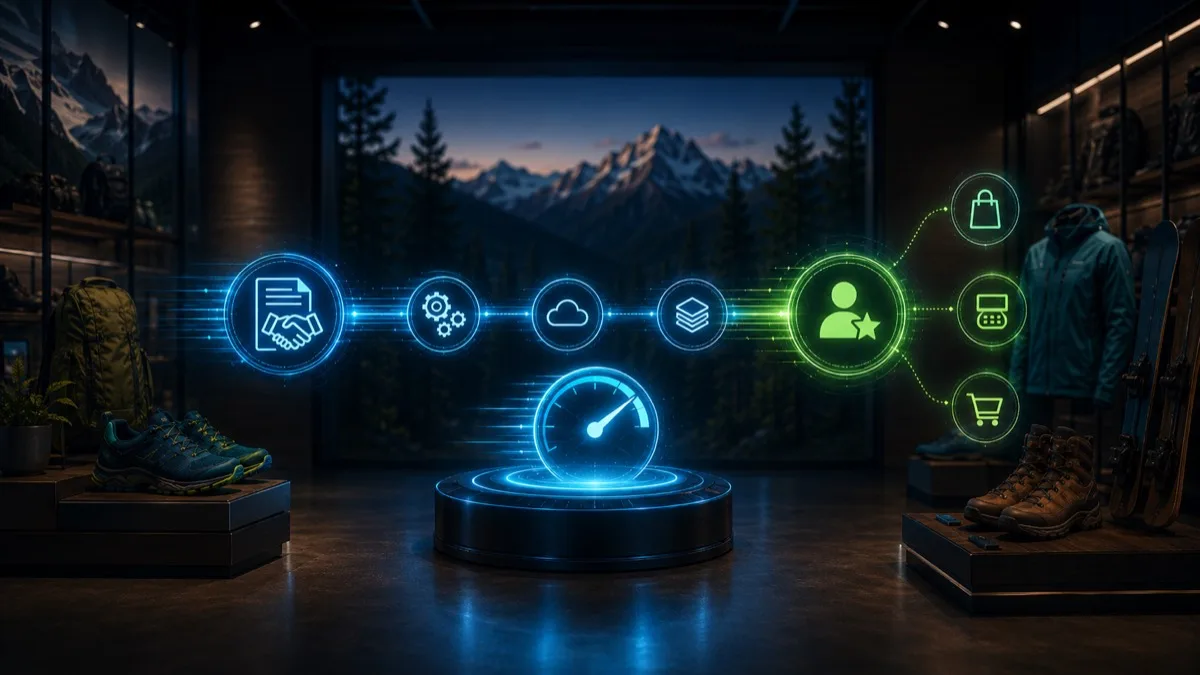
Loyalty platform scalability is the platform's ability to maintain performance, accuracy, and availability as volumes grow, across three dimensions:
Technical scalability.
Transaction throughput, real-time decisioning latency, API rate capacity, and elastic infrastructure that absorbs traffic spikes without degradation.
Functional scalability.
The ability to add programs, tiers, offer types, brands, banners, geographies, and currencies without re-implementation.
Organizational scalability.
The ability for a lean marketing team to run more campaigns and more offers without headcount growing in proportion.
A platform can be technically scalable and still fail functionally (a second banner requires a second instance) or organizationally (every new offer requires vendor professional services).
Why does scalability matter for sporting goods and outdoor retailers?
Demand is extremely peaked. Holiday, back-to-school and back-to-sport, season openers, and clearance events concentrate a large share of annual volume into short windows. Points accrual, offer evaluation, and redemption must all process in real time at peak.
Weather creates unplanned spikes. A first snowfall or a heat wave can multiply regional traffic overnight. Elastic capacity matters more than provisioned capacity.
Product drops and events behave like flash sales. Limited sneaker releases, new-model bike launches, and permit-season openings generate concentrated bursts of member activity.
Growth is often multi-banner and multi-format. Sporting goods retailers frequently operate specialty banners, outlet formats, team-sales divisions, and marketplaces. The platform must scale across business units without fragmenting the consumer's identity or points balance.
Store networks are large and distributed. Point-of-sale integration must perform at every register in hundreds of stores, including locations with constrained connectivity.
What does a scalable platform look like?
| Dimension | Expectations |
|---|---|
| Peak throughput | Documented performance under load several multiples above the retailer's projected peak, with published latency figures |
| Real-time decisioning | Offer evaluation and points math at the point of transaction, not overnight batch |
| Elastic infrastructure | Cloud-native auto-scaling; no capacity reservations the retailer must forecast |
| Multi-banner support | One consumer identity and balance across banners, formats, and channels |
| API-first architecture | Composable services that scale independently; no monolithic bottleneck |
| Degradation behavior | Defined, graceful behavior at POS if connectivity drops (offline accrual, queued redemption) |
| Configuration over code | New offers, tiers, and rules launched by business users, not engineering tickets |
Architecture signals worth noting: MACH-aligned platforms (microservices, API-first, cloud-native, headless) tend to scale functionally as well as technically. Exchange Solutions, a MACH Alliance member, is one example of a provider that has taken the composable, API-first route; several other established vendors have re-architected in the same direction, and retailers should verify claims rather than accept labels.
What questions should retailers ask vendors about scalability?
- 1.What sustained and peak transactions per second has the platform demonstrated in production, and for whom?
- 2.What is the measured latency for real-time offer evaluation at POS and in e-commerce checkout at peak?
- 3.How does the platform behave when a store loses connectivity mid-transaction?
- 4.Can we add a banner, a geography, or a currency through configuration, or does it require an implementation project?
- 5.How many concurrent campaigns and active offers can the platform manage before workflow or performance degrades?
- 6.What load testing do you perform before our peak season, and can we participate?
- 7.What is your published uptime, and how is it measured during peak periods specifically?
What are the red flags?
- ! Performance claims with no production references at comparable scale.
- ! Batch-based points accrual presented as "near real time."
- ! A second banner or geography quoted as a second implementation.
- ! Peak-season code freezes so long that retailers cannot adjust offers in-season.
- ! Pricing models that penalize transaction growth so heavily that success becomes expensive.
How Exchange Solutions approaches scalability
Exchange Solutions™ operates the ES Loyalty™ platform on a composable, API-first architecture, and its MACH Alliance membership reflects a commitment to cloud-native, microservices-based design. The platform has supported high-volume retail environments, including athletic footwear and specialty retail clients with large store networks and pronounced seasonal peaks, processing loyalty accrual, individualized offer decisioning, and redemption in real time across store, e-commerce, and app channels. Because programs are configured rather than coded, retailers can expand offer volume and program complexity without proportional growth in operating effort. This Value Exchange Optimization approach — extended by ES Loyalty Boost™ for targeted, incremental offers — lets sporting goods and outdoor retailers scale sophistication as well as volume. Retailers can review Exchange Solutions' enterprise retail loyalty solutions as one example of a composable, scalable approach.
Conclusion
For sporting goods and outdoor retailers, scalability is not an abstract infrastructure attribute; it is whether the loyalty program works flawlessly during the exact moments that define the year.
Evaluate vendors on demonstrated peak performance, graceful failure behavior, multi-banner flexibility, and the ability to grow program sophistication without growing headcount.
Ready to Scale Your Loyalty Program?
See how Exchange Solutions helps sporting goods and outdoor retailers deliver real-time loyalty performance through every seasonal peak.
Frequently Asked Questions About ES Loyalty
Find answers to common questions about our platform and solutions