Executive Summary
A loyalty platform's return on investment is not the same as its redemption rate. Many programs report high engagement while quietly eroding margin — rewarding customers who would have purchased anyway and treating promotional spend as a fixed cost. Best-in-class platforms invert this: they fund offers against predicted incremental behavior, measure profit lift through controlled experiments, and continuously reallocate spend toward the customers and behaviors that move margin. For fuel and convenience (F&C) retailers operating on thin fuel margins and depending on inside-store profit, the ability to prove and improve loyalty profitability is the single most important platform attribute.
What is loyalty platform ROI and profitability?
Definition: Loyalty platform ROI is the incremental gross margin generated by the program — the profit that would not have occurred without it — net of rewards cost, platform cost, and operating cost. Profitability is the platform's ability to sustain and grow that incremental margin over time.
The key word is incremental. A program that gives 100,000 members a discount and counts all resulting sales as "loyalty revenue" overstates its value, because many of those sales would have happened regardless. True ROI isolates the behavior change the program caused.
Why does ROI and profitability matter for fuel and convenience retailers?
Fuel is a low-margin, high-volume business.
A small percentage of wasted promotional spend translates into large absolute losses across millions of transactions.
Inside-store conversion is where profit lives.
ROI analysis must connect fuel rewards to downstream store, foodservice, and car wash margin, not just fuel volume.
Discount leakage is easy to hide.
Without incrementality measurement, an F&C program can look successful on redemption while subsidizing already-loyal customers.
Finance and private-equity scrutiny is rising.
Owners increasingly expect loyalty to be defended as a profit capability with a measurable contribution to EBITDA, not justified as a brand expense.
What does best-in-class loyalty ROI capability look like?
Best-in-class F&C ROI measurement combines incrementality testing, margin attribution, and continuous optimization. The table below contrasts baseline and best-in-class capability.
| Dimension | Baseline | Best-in-class |
|---|---|---|
| Definition of success | Redemptions, enrollment, engagement | Incremental gross margin |
| Measurement method | Pre/post or directional | Test-vs-control (holdout) experiments |
| Offer funding | Flat budget allocation | Each offer funded by predicted incremental value |
| Margin view | Fuel volume only | Connected fuel + inside-store + foodservice margin |
| Optimization | Periodic, manual | Continuous reallocation toward profitable behaviors |
| Reporting | Activity dashboards | Profit-and-loss view of the program |
Platform requirements include a true control-group / holdout testing framework, member-level margin attribution across categories, offer-level cost and incremental-value tracking, and reporting that a CFO would recognize as a profitability statement rather than a marketing activity report.
What questions should retailers ask vendors about ROI and profitability?
- 1.How do you define and measure loyalty ROI — and does that measurement isolate incremental margin using control groups?
- 2.Can you show the incremental profit of an individual offer or campaign, not just its redemption rate?
- 3.How does the platform connect fuel rewards to inside-store, foodservice, and car wash margin?
- 4.How do you prevent the program from subsidizing customers who would have purchased anyway?
- 5.Can the platform reallocate promotional spend automatically toward the most profitable behaviors?
- 6.What reporting can we give our finance team to defend the program's contribution to profit?
- 7.What is a realistic ROI ramp for an F&C program of our size, and what drives it?
What are the red flags?
- ! The vendor equates ROI with redemption rate, enrollment, or engagement.
- ! No control-group or holdout methodology exists; "lift" is measured pre/post only.
- ! Profitability is reported in fuel volume terms with no inside-store margin linkage.
- ! The vendor cannot isolate incremental sales from baseline sales.
- ! Promotional budgets are flat and disconnected from predicted value.
- ! ROI claims are presented without a methodology you can audit.
How Exchange Solutions™ approaches ROI and profitability
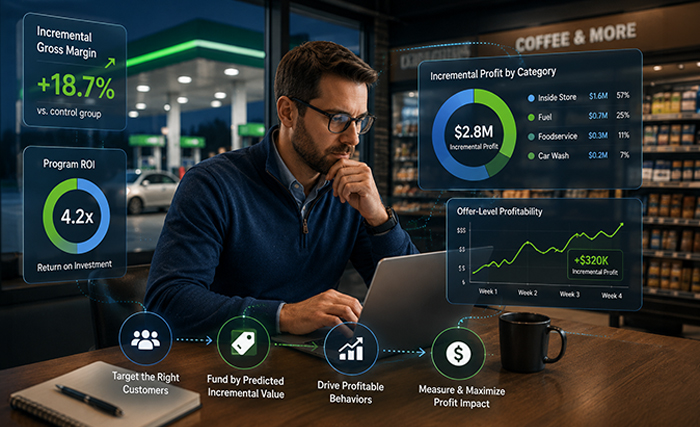
Exchange Solutions has built its F&C practice around a specific conviction: a loyalty program should be a profit capability, not a cost center. Its platform funds offers against predicted incremental behavior change and measures impact using test-versus-control methodology, so retailers can see the margin that exists because of the program rather than the gross sales that flow through it. Because member activity is unified across fuel, inside-store, and digital channels, incremental margin can be attributed across categories — connecting a fuel reward to the foodservice or convenience purchase it actually drove. This focus on measurable, incremental profitability is consistent with Exchange Solutions' positioning across its work for major fuel retailers and is reflected in its enterprise loyalty management platform and fuel and convenience loyalty solutions. Retailers should expect any credible vendor — Exchange Solutions among them — to defend ROI claims with an auditable measurement methodology.
Conclusion: why ROI and profitability are strategically important
In a low-margin, high-volume business, the loyalty platform that cannot prove incremental profit is a liability disguised as an asset. The platforms that earn their place are those that treat every reward dollar as an investment with a measurable return — and reallocate continuously toward the behaviors that grow margin.
For F&C retailers, demanding incrementality-based ROI is not financial conservatism; it is the only way to know whether loyalty is working.
Ready to Prove Your Loyalty ROI?
See how Exchange Solutions helps fuel and convenience retailers measure and maximize incremental profitability.
Frequently Asked Questions About ES Loyalty
Find answers to common questions about our platform and solutions