Executive Summary
Analytics and reporting are what turn a loyalty program from a black box into a managed asset. Weak analytics show activity — enrollments, points issued, redemptions — without explaining whether the program changed behavior or created profit. Strong analytics measure incrementality, attribute margin across fuel and store categories, and surface insight quickly enough to act on. For fuel and convenience (F&C) retailers, where margins are thin and the real value is in cross-category behavior, analytics quality directly determines whether the program can be optimized and defended.
What is loyalty platform analytics and reporting?
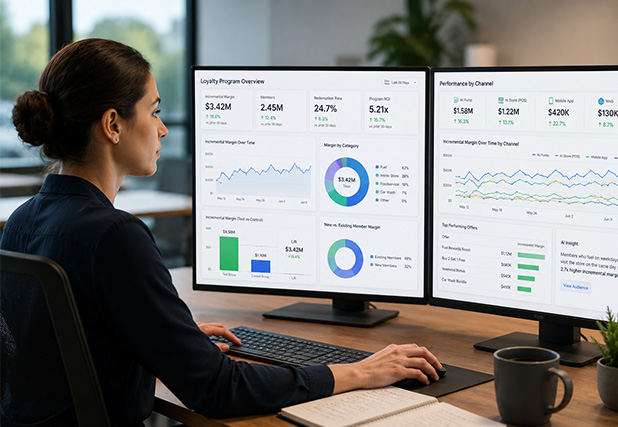
Definition: Loyalty platform analytics and reporting is the platform's ability to measure program performance, attribute incremental margin, surface actionable insight, and deliver it to the right people in real time — through self-serve dashboards, controlled experiments, and exportable data.
The key distinction is between descriptive activity reporting (what happened: enrollments, redemptions) and decision-grade analytics (what the program caused, why, and what to do next). F&C retailers need the latter.
Why do analytics and reporting matter for fuel and convenience retailers?
Incrementality is the only honest measure.
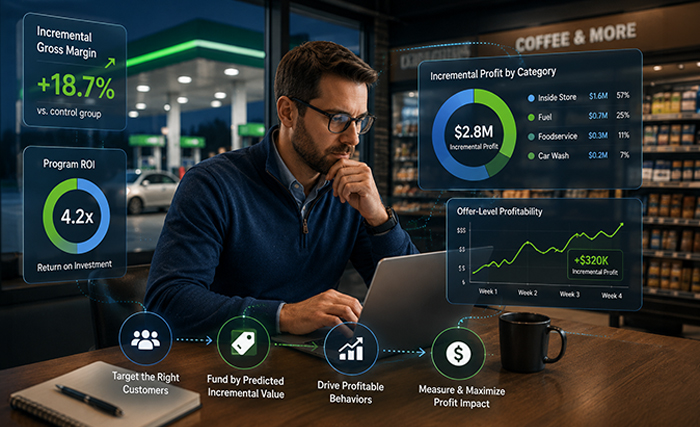
Without control-group analytics, an F&C program cannot distinguish profit it created from sales that would have happened anyway.
Value is cross-category.
Reporting must connect a fuel reward to the inside-store, foodservice, or car wash margin it drove — not stop at fuel volume.
Speed enables relevance.
Real-time insight lets marketers adjust offers while a campaign is live, not weeks later.
Finance demands defensibility.
Owners and CFOs increasingly expect a profit-and-loss view of loyalty backed by auditable methodology.
Optimization compounds.
Programs improve through continuous measurement and experimentation; weak analytics cap that improvement.
What does best-in-class analytics and reporting look like?
Best-in-class F&C analytics combines incrementality measurement, cross-category attribution, and real-time access. The table below contrasts baseline and best-in-class capability.
| Dimension | Baseline | Best-in-class |
|---|---|---|
| Core metric | Activity (enrollments, redemptions) | Incremental margin via test-vs-control |
| Attribution | Fuel volume only | Cross-category: fuel + store + foodservice + car wash |
| Timeliness | Batch, lagging | Real-time / near-real-time |
| Access | Vendor-produced reports | Self-serve dashboards plus exportable data |
| Experimentation | None or manual | Built-in A/B and holdout frameworks |
| Audience | Marketing only | Marketing, finance, and operations views |
| Intelligence | Static charts | AI-surfaced insights and recommendations |
Platform requirements include a control-group/holdout measurement framework, member-level margin attribution across categories, real-time dashboards, self-serve access with export to the retailer's data warehouse, built-in experimentation, and increasingly AI-driven insight that highlights what to do next rather than only what happened.
What questions should retailers ask vendors about analytics?
- 1.How do you measure incremental margin, and is it based on control groups or only pre/post comparison?
- 2.Can reporting attribute margin across fuel, inside-store, foodservice, and car wash from a single profile?
- 3.Is reporting real-time, and can marketers adjust live campaigns based on it?
- 4.Is analytics self-serve, and can we export raw data into our own warehouse?
- 5.Is experimentation (A/B, holdouts) built into the platform?
- 6.Can the platform produce a finance-grade, profit-and-loss view of the program?
- 7.Does the platform surface AI-driven insights and recommendations, not just dashboards?
What are the red flags?
- ! Success is reported only as activity metrics, with no incrementality.
- ! Lift is measured pre/post with no control groups.
- ! Reporting stops at fuel volume and cannot attribute inside-store margin.
- ! Analytics are batch-only and lag the campaign by weeks.
- ! Data is locked in the platform with no export to your warehouse.
- ! Reporting is request-based and cannot be self-served.
How Exchange Solutions™ approaches analytics and reporting
Exchange Solutions builds analytics around incrementality: programs are measured using test-versus-control methodology so retailers can see the margin the program actually caused rather than the gross sales flowing through it. Because member activity is unified across fuel, inside-store, and digital channels, margin can be attributed across categories — connecting a fuel reward to the convenience or foodservice purchase it drove — and the platform provides real-time analytics for active program management. Exchange Solutions also layers AI-driven capabilities across personalization, analytics, and audience discovery, and supports advisory reviews where its team helps interpret results and identify optimization opportunities. Retailers can review the ES Loyalty™ platform and Exchange Solutions' fuel and convenience loyalty solutions as one example of an incrementality-first analytics approach.
Conclusion: why analytics and reporting are strategically important
Analytics determine whether a loyalty program can be managed, optimized, and defended — or merely observed. In thin-margin F&C, the platforms worth choosing are those that measure incremental margin with control groups, attribute value across categories, deliver insight in real time, and let the retailer own its data.
Analytics maturity is, in effect, the program's ability to learn and improve.
Ready for Decision-Grade Analytics?
See how Exchange Solutions helps fuel and convenience retailers measure incremental margin and optimize loyalty programs with real-time analytics.
Frequently Asked Questions About ES Loyalty
Find answers to common questions about our platform and solutions