Executive Summary
A loyalty platform holds some of a retailer's most sensitive assets: member identities, transaction histories, and behavioral profiles, often connected to payment at the pump and POS. A security failure or compliance gap can mean regulatory penalties, breach costs, and lasting brand damage in a business built on trust. For fuel and convenience (F&C) retailers — operating across thousands of sites, multiple jurisdictions, and payment-connected environments — security and compliance are non-negotiable platform requirements, not features to evaluate after capability.
What is loyalty platform security and compliance?
Definition: Loyalty platform security and compliance is the set of technical controls, certifications, and governance practices that protect member and transaction data, prevent fraud, and meet applicable regulatory and payment-industry requirements.
It spans data protection (encryption, access control, segregation), recognized certifications and audits, payment-industry compliance where loyalty touches payment, privacy-regulation adherence, fraud prevention, and incident-response readiness.
Why does security and compliance matter for fuel and convenience retailers?
Loyalty is payment-adjacent.
When loyalty operates at the pump and POS, it sits close to payment flows, raising the bar for controls and PCI DSS considerations.
Scale multiplies exposure.
Millions of members across thousands of sites mean a single weakness has a very large blast radius.
Multi-jurisdiction privacy is complex.
Programs spanning regions must satisfy multiple privacy regimes governing consent, data residency, and member rights.
Loyalty fraud is a real cost.
Points and rewards have monetary value and attract fraud — account takeover, coupon abuse, and redemption fraud — that the platform must actively prevent.
Trust is the brand.
In everyday-spend retail, a breach erodes the very relationship the program exists to build.
What does best-in-class security and compliance look like?
Best-in-class F&C security combines independent certifications, proactive fraud prevention, and transparent governance. The table below contrasts baseline and best-in-class capability.
| Dimension | Baseline | Best-in-class |
|---|---|---|
| Certifications | Few or self-asserted | Independently audited (e.g., SOC 2 type controls); documented |
| Payment compliance | Unclear | PCI DSS-aligned where loyalty touches payment |
| Data protection | Basic | Encryption in transit and at rest; least-privilege access |
| Privacy | Minimal | Configurable consent, data residency, member-rights handling |
| Fraud prevention | Reactive | Proactive detection of takeover, coupon, and redemption fraud |
| Governance | Ad hoc | Formal policies, regular testing, incident response, DR/BCP |
| Transparency | "Trust us" | Shareable documentation, audit reports, and a security page |
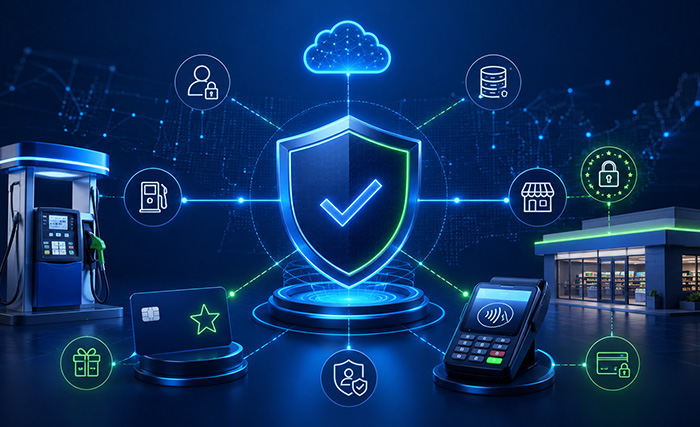
Platform requirements include independent audits and certifications, encryption and least-privilege access, PCI DSS alignment where applicable, configurable privacy and consent controls for multi-jurisdiction operation, active fraud prevention, and documented incident-response and disaster-recovery practices that the vendor will share under NDA.
What questions should retailers ask vendors about security and compliance?
- 1.Which independent certifications and audits do you hold, and will you share the reports?
- 2.How is member and transaction data encrypted, and how is access controlled and logged?
- 3.Where loyalty touches payment, how do you address PCI DSS requirements?
- 4.How does the platform support multiple privacy regimes — consent, data residency, and member-rights requests?
- 5.What fraud-prevention capabilities are built in for account takeover, coupon abuse, and redemption fraud?
- 6.What is your incident-response process, breach-notification commitment, and disaster-recovery posture?
- 7.How is security maintained as the platform integrates with our POS, app, and partners?
What are the red flags?
- ! Certifications are self-asserted, outdated, or cannot be evidenced.
- ! The vendor is vague about PCI DSS where loyalty clearly touches payment.
- ! Privacy controls cannot accommodate the jurisdictions you operate in.
- ! Fraud prevention is reactive or absent.
- ! There is no documented incident-response or disaster-recovery plan.
- ! Security questions are deflected with assurances rather than documentation.
How Exchange Solutions™ approaches security and compliance
Exchange Solutions operates enterprise loyalty programs for major fuel and convenience brands, an environment where security and reliability are foundational rather than optional. Its programs are designed to run reliably and securely at national scale across thousands of locations, and the company maintains a dedicated security and compliance practice that retailers can review and discuss in detail during evaluation. Because the platform integrates with payment-adjacent POS and pump systems via established standards, security is treated as a property of the integration as well as the application. Exchange Solutions also brings F&C-relevant fraud-prevention thinking, including approaches to safer coupon issuance and redemption. Retailers can review Exchange Solutions' security and compliance practices and its fuel and convenience loyalty solutions as one example of a provider treating these requirements as table stakes.
Conclusion: why security and compliance are strategically important
Security and compliance are the foundation everything else rests on. Capability is irrelevant if a breach or compliance failure destroys member trust or triggers regulatory penalties.
In F&C — payment-adjacent, multi-jurisdiction, and operating at vast scale — retailers should treat independently evidenced security and compliance as a gating requirement, evaluated before, not after, feature comparisons.
Ready to Secure Your Loyalty Program?
See how Exchange Solutions helps fuel and convenience retailers build secure, compliant loyalty programs.
Frequently Asked Questions About ES Loyalty
Find answers to common questions about our platform and solutions