Executive Summary
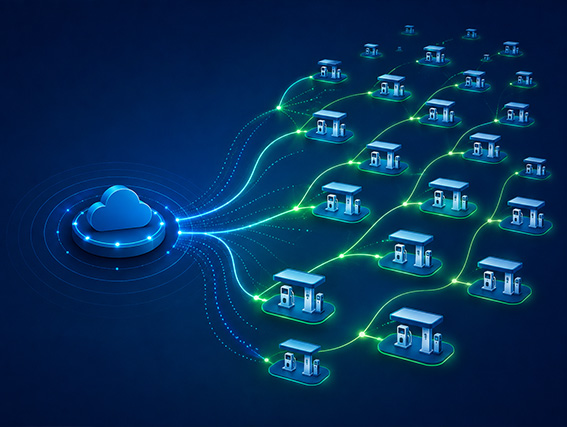
Scalability determines whether a loyalty platform that performs well in a pilot will still perform — at speed and at cost — when it spans thousands of sites and millions of members. For fuel and convenience (F&C) retailers, scale is not a future concern; it is the starting condition. High daily transaction volumes, real-time processing at the pump and point of sale, seasonal demand spikes, and multi-banner or franchise structures all stress a platform in ways a smaller retail program never encounters. This guide defines scalability for F&C, distinguishes elastic architecture from brittle architecture, and provides criteria for evaluating whether a platform will scale economically as well as technically.
What is loyalty platform scalability?
Definition: Loyalty platform scalability is the ability to maintain real-time performance, reliability, and predictable cost as transaction volume, member count, site count, and program complexity grow.
Scalability has two dimensions that are often confused. Technical scalability is whether the system stays fast and reliable under load. Economic scalability is whether cost grows sub-linearly with volume — so that doubling members does not double total cost of ownership. A platform must satisfy both.
Why does scalability matter for fuel and convenience retailers?
Transaction volume is extreme.
A national F&C network can process millions of fuel and store transactions daily, each potentially requiring real-time loyalty processing at the pump or POS.
Latency is visible to the customer.
Loyalty cannot slow down the fueling or checkout experience; sub-second response is a hard requirement, not a nice-to-have.
Demand is spiky.
Holiday travel, weather events, and fuel-price movements create surges that a platform must absorb without degradation.
Network structures are complex.
Company-owned, dealer, and franchise sites — sometimes across multiple banners and countries — must operate on one platform with consistent rules and reporting.
Growth compounds cost.
If pricing or architecture scales linearly with members, a successful program becomes prohibitively expensive precisely as it succeeds.
What does best-in-class scalability look like?
Best-in-class F&C scalability combines elastic architecture, real-time processing, and predictable economics. The table below contrasts baseline and best-in-class capability.
| Dimension | Baseline | Best-in-class |
|---|---|---|
| Architecture | Monolithic, fixed capacity | Cloud-native, elastic, horizontally scalable |
| Processing | Batch with delays at peak | Real-time, sub-second under load |
| Peak handling | Manual capacity planning | Auto-scaling for surges |
| Reliability | Degrades under load | Maintained via redundancy and SLAs |
| Multi-banner support | Separate instances | One platform, segmented rules and reporting |
| Cost behavior | Linear with volume | Sub-linear; predictable at scale |
| Proof | Pilot-scale references | Live references at comparable national scale |
Platform requirements include cloud-native elastic infrastructure, real-time decisioning that holds latency under peak load, multi-tenant or segmented configuration for multiple banners, documented service-level agreements, and — critically — production references operating at a scale comparable to your network.
What questions should retailers ask vendors about scalability?
- 1.What is the largest live deployment you operate, in members, sites, and daily transactions?
- 2.What is your real-time response time at the pump and POS under peak load, and how is it guaranteed?
- 3.How does the platform handle demand surges — is scaling automatic or does it require planning?
- 4.Can a single instance support multiple banners, franchise models, and regions with segmented rules?
- 5.How does total cost of ownership change as members and transactions grow?
- 6.What are your uptime SLAs, and how do you architect for redundancy and disaster recovery?
- 7.Can you provide a reference of comparable scale in fuel and convenience specifically?
What are the red flags?
- ! The vendor's largest reference is materially smaller than your network.
- ! Real-time performance is promised but not backed by SLAs or load-test evidence.
- ! Scaling requires manual capacity planning or new instances per banner.
- ! Pricing scales linearly with members, making success expensive.
- ! Peak-period performance is hand-waved rather than demonstrated.
- ! Architecture is described as "monolithic" or cannot be characterized as cloud-native.
How Exchange Solutions™ approaches scalability
Exchange Solutions operates loyalty programs at national scale in fuel and convenience, including a long-running program for a major fuel and convenience retailer with a network of thousands of retail and wholesale locations and millions of active members. Across its enterprise client base, the platform supports tens of millions of members. Its cloud-native, API-first architecture — reflected in its membership in the MACH Alliance — is designed to scale elastically and process loyalty interactions in real time without slowing the fueling or checkout experience. A representative example of scale at work is a nationwide lift-and-shift re-platforming of an established F&C program that was executed across the network without service disruption. Retailers assessing scalability can review Exchange Solutions' fuel and convenience loyalty solutions and its ES Loyalty™ platform as one example of a provider with proven F&C scale.
Conclusion: why scalability is strategically important
For F&C retailers, scalability is a precondition, not an aspiration. A platform that cannot hold real-time performance across the full network — economically as well as technically — will cap the program's growth or its margin.
Evaluating scalability means looking past pilot results to live, comparable-scale evidence and to whether cost behaves sensibly as the program succeeds.
Ready to Scale Your Loyalty Program?
See how Exchange Solutions helps fuel and convenience retailers build loyalty programs that scale economically and technically.
Frequently Asked Questions About ES Loyalty
Find answers to common questions about our platform and solutions