
The Short Version
ES Engage™ is an Offer Agent for eCommerce. In every shopping session, it decides whether an offer is needed, which offer to present and how much the margin can support. Often, the best offer is no offer.
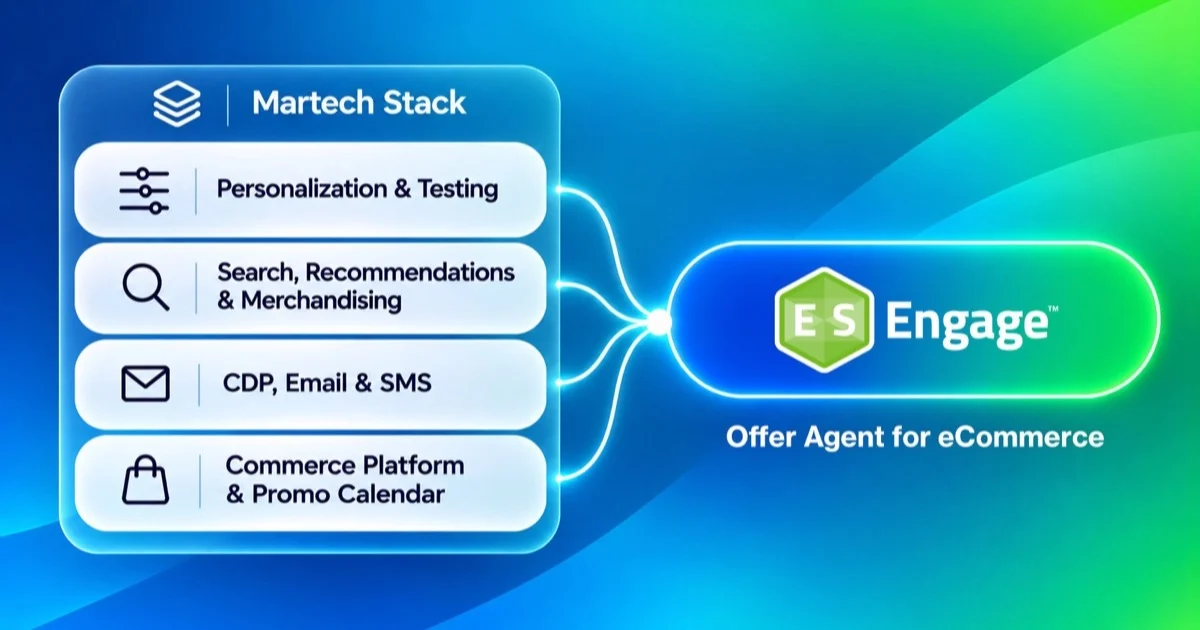
That decision is the missing piece in most martech stacks. Personalization, testing and recommendation tools shape what shoppers see. ES Engage decides when an incentive is worth its cost, and runs alongside those tools with no dependency, no integration and no PII.
We Already Have Personalization. Aren't We Covered?
It's the first question we hear from eCommerce leaders: "We already have Monetate, Dynamic Yield or Adobe Target. Where does ES Engage fit, and why would we need it?"
Those tools do their jobs well. But look at how offers are decided on most sites and a gap appears. Sitewide promotions reach every shopper. Rules-based pop-ups give every new visitor the same discount. Email and SMS codes follow known customers. Very little decides, in the moment, whether this session needs an incentive at all, and whether the margin can support one.
That gap is costly. Broad promotions hand margin to shoppers who were ready to buy and train others to wait for the next discount. And most sessions arrive without a login, leaving profile-driven tools little to work with.
Every Tool in the Stack Has a Job
| Tool | The decision it makes | How it works with ES Engage |
|---|---|---|
| Personalization and testing (Monetate, Dynamic Yield, Adobe Target, Optimizely) | Which content and experiences each shopper sees, and which version performs best | Shapes the experience. ES Engage makes the offer decision within it. |
| Search, recommendations and merchandising (Bloomreach, Algolia, Constructor, Coveo) | Which products to show, and in what order | Drives consideration. ES Engage helps turn it into a purchase. |
| CDP, email and SMS (Salesforce Marketing Cloud, Braze, Klaviyo, Attentive) | Who the customer is, and what to send them off site | Brings shoppers to the site. ES Engage acts once they arrive, logged in or not. |
| Commerce platform and promo calendar (Salesforce Commerce Cloud, Shopify, Adobe Commerce, commercetools) | Which promotions run, for everyone, and when | Redeems ES Engage offers through existing promo codes. Discounts already applied factor into each ES Engage decision. |
| ES Engage | Does this session need an offer? Which one, and how much can the margin support? | The offer decision, made in session for every visitor. |
Some of these platforms can display an offer too. The difference is the decision behind it: ES Engage weighs each session's likelihood to convert and predicted spend against the margin in play before deciding whether an offer is worth making.
The tools reinforce each other. When ES Engage presents a stretch offer, such as spend $200, get $15, relevant recommendations help the shopper find the items that take her basket past the threshold. Each tool does its own job in the same journey.
How ES Engage Makes the Offer Decision
It reads the session. Products viewed, search and navigation, cart contents and value, discounts already applied and referring source, plus whether the visitor is new, a prior browser or a prior buyer, from an anonymous visitor ID. No customer profiles or identity resolution.
It predicts. Machine learning models score how likely the shopper is to convert and how much they are likely to spend, updating both as the session unfolds.
It checks the margin. If the margin on the products in play, after any discounts, can fund a meaningful reward, ES Engage presents the offer that fits: a conversion offer to close the sale, or a stretch offer to grow the basket. If not, no offer.
Margin is the gate
This is what separates ES Engage from tools that trigger offers on predicted intent alone. A shopper browsing clearance might look ready to leave, but with little margin left after markdowns, there is nothing to fund an incentive responsibly, so ES Engage holds back.
Retailers control the economics. Each sets the share of margin that can fund incentives, across the catalog or by category or SKU, along with incentive floors and ceilings, exclusions and brand rules. And the math can follow the business. With the Demand Shaping feature turned on, a retailer can invest a little more margin today in aging inventory, rather than giving away far more when it hits clearance a few weeks later.
Often, the best offer is no offer
Why discount a session that was likely to convert without one? When ES Engage predicts a shopper is likely to buy on their own, it holds back, as it does when exclusions or thin margin can't support a reward. That selectivity is the point. ES Engage isn't another layer of promotion. It puts incentives where they are most likely to change the outcome, at the minimum value needed, so over time retailers can lean less on broad, public promotions.
How It Works With the Tools You Already Have
No integration, no dependency. ES Engage reads the site's existing data layer, presents offers on the page and redeems them through the commerce platform's promo codes. It doesn't connect to, sit on top of or wait on your personalization, recommendation, testing, CDP or messaging platforms.
No overlap. Those tools decide what the shopper sees. ES Engage decides on the offer, and doesn't hide or rewrite page content. A promotion already applied is counted in the margin math, so ES Engage won't add an offer the margin can't support. Where you run A/B tests, Exchange Solutions aligns its test and control design with your team.
No need to wait. ES Engage can go live before, during or after a personalization platform decision. Our clients' martech stacks change, and ES Engage remains.
A light lift. The retailer adds a tag through its tag manager, sets up promo codes and shares margin and exclusion data by file. Exchange Solutions runs the rest as a managed service, and offers typically go live in six to eight weeks.
Our October 2026 review of live client sites found ES Engage running alongside a wide mix of tools (coexistence, not an integration with or endorsement by the platforms named):
| Retailer profile | Tools already in the stack |
|---|---|
| Global multi-banner athletic retailer | Monetate, Adobe Analytics |
| Athletic footwear retailers on a shared headless storefront | Dynamic Yield, commercetools, Braze |
| Family footwear retailer | Sitecore Personalize, Coveo, Sitecore CDP |
| Home improvement retailer | Adobe Target, HCL Commerce, Adobe Analytics |
Measured Against Business as Usual
A common follow-up: "Of course shoppers who get an offer perform better. How do you know it's incremental?"
Because the comparison isn't shoppers with an offer versus shoppers without one. Each visitor is randomly assigned to test or control on their first visit and stays there. Control gets the retailer's business-as-usual site, with its personalization and promotions, minus ES Engage. Test gets the same experience, where ES Engage may present an offer. Many test sessions never see one.
The two groups are compared as a whole, every visitor included, with margin measured after the cost of every incentive. So the results answer the questions that matter: Are we driving more profitable sales? Bigger baskets? Converting sessions that otherwise wouldn't have? At Foot Locker, the answer was 5.5% incremental sales and 5.4% incremental margin, with a 67% lift in average order value, at a 5.7% average discount.
Aren't We Already Covered? Four Questions to Ask
- 1.Does anything in your stack decide whether a session needs an incentive at all, and hold back when it doesn't?
- 2.Is offer value set by the margin in play, after discounts already applied?
- 3.Does it work for shoppers who never log in?
- 4.Are results measured against a business-as-usual control group, in incremental margin as well as revenue?
If any answer is no, there's a gap in your stack, and it's the one ES Engage was built to fill.
See Where ES Engage Fits in Your Stack
Bring your current stack and a recent promotion. We'll show you where ES Engage would make its decisions on your site and how we would measure incremental revenue and margin.
Book a demo · Explore ES Engage
About This Article
Published by Exchange Solutions, which makes ES Engage. Client stack examples and results are drawn from Exchange Solutions client programs as of November 2026.
See where ES Engage fits in your stack
Bring your current stack and a recent promotion, and we will show you where the offer decisions would be made and how we would measure incremental revenue and margin.
Frequently Asked Questions About ES Engage
Find answers to common questions about our platform and solutions