Retailers are under growing pressure to increase AOV profitably
When retail conversion slows, many organizations default to sitewide promotions, cart abandonment discounts, flash sales, and percentage-off offers. In the short term, these strategies often increase average order value (AOV).
But over time, retailers face growing challenges: margin erosion, promotion fatigue, reduced perceived product value, and customers conditioned to wait for discounts.
The real challenge is not simply how to increase average order value. It is how to increase AOV while protecting profitability and strengthening long-term customer engagement.
Why traditional discounting strategies are becoming less effective
Modern consumers are highly promotion-aware. Many shoppers now delay purchases intentionally, compare retailers extensively, and expect discounts as part of the online shopping experience.
As a result, many retailers struggle to determine whether a promotion actually influenced customer behavior or whether the customer would have purchased anyway.
This is one reason retailers are increasingly shifting toward real-time personalization, behavioral engagement, offer optimization, and customer engagement strategies based on live shopping behavior.
What actually increases average order value
Higher-performing retail experiences tend to focus less on blanket promotions and more on relevance, timing, behavioral context, and perceived customer value.
- A shopper repeatedly browsing premium products may respond better to personalized recommendations than generic discounts.
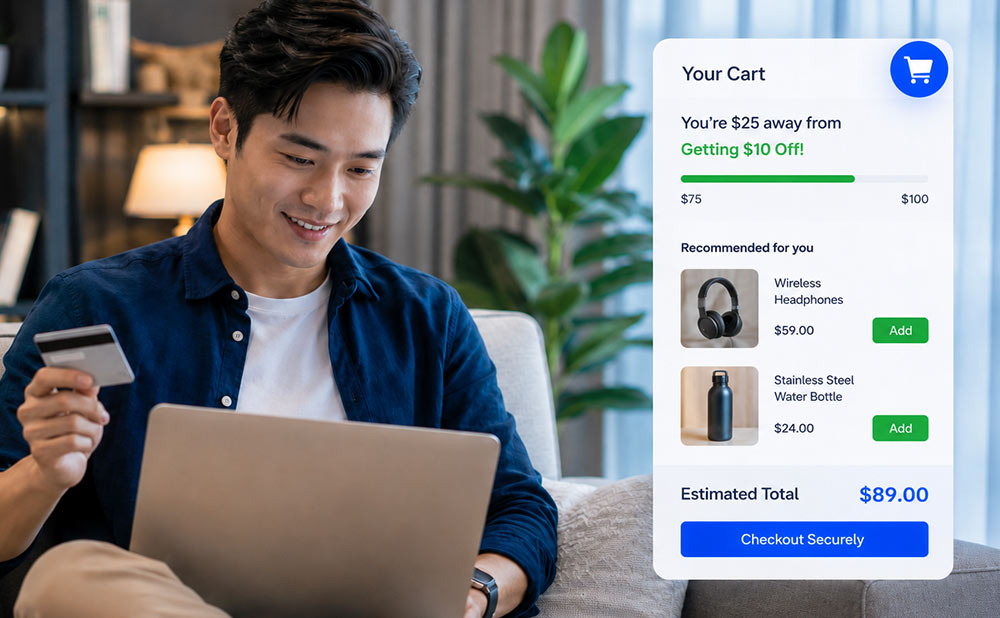
- A customer approaching a shipping threshold may only need a small contextual incentive to increase basket size.
- A returning anonymous visitor showing strong intent may benefit from real-time engagement during the session itself.
These approaches influence customer behavior without training customers to expect constant markdowns.
The shift toward real-time personalization and customer engagement
One of the biggest changes in retail personalization strategy is timing. Traditional retail marketing systems often engage after the session, through scheduled campaigns, or using static customer segments.
But customer purchase intent is strongest while the shopper is actively browsing.
This is why many retailers are extending loyalty and customer engagement strategies into live shopping experiences through real-time personalization, session-aware offers, behavioral triggers, dynamic offer optimization, and anonymous visitor engagement.
These capabilities help retailers improve conversion rates, average order value, customer engagement, margin efficiency, and loyalty participation simultaneously.
What retailers commonly get wrong
Many retailers still assume more promotions equal more revenue. But in practice, blanket discounts often reduce incremental profit, promotions are overused on customers already likely to convert, valuable anonymous website visitors receive little personalization, and loyalty strategy and conversion optimization operate separately.
Leading retailers increasingly treat loyalty, personalization, and customer engagement as connected parts of the same customer value strategy.
How modern loyalty strategy supports higher AOV
A strong customer loyalty program can improve AOV by increasing customer trust, improving purchase confidence, supporting personalized engagement, and enabling more intelligent offer strategies.
But loyalty programs alone are not always enough during active shopping sessions. This is where modern customer engagement capabilities can extend loyalty influence in real time through contextual offers, behavioral engagement, anonymous traffic personalization, and dynamic customer experiences.
Rather than replacing loyalty programs, these capabilities help loyalty ecosystems become more commercially effective during high-intent customer moments.
What leading retailers are doing differently
Retailers improving AOV without excessive discounting are increasingly:
- Using behavioral signals instead of static segmentation.
- Triggering customer engagement during high-intent sessions.
- Personalizing experiences for anonymous and identified visitors.
- Measuring incrementality instead of campaign activity.
- Optimizing for profitability, not just conversion volume.
This represents a broader shift from campaign-based retail marketing toward real-time behavioral influence.
Questions retailers should be asking
Are promotions truly changing customer behavior, or are they subsidizing existing demand?
Can customer engagement strategies influence shoppers during active sessions?
Are anonymous website visitors receiving personalized experiences?
Is personalization dynamic, or simply preconfigured segmentation?
Does the retailer's loyalty strategy connect to real-time customer engagement?
Final takeaway
Retailers do not need to eliminate promotions entirely. But long-term retail growth increasingly depends on moving beyond blanket discounting toward real-time personalization, behavioral engagement, intelligent offer optimization, and connected customer loyalty ecosystems.
The retailers seeing the strongest results are combining loyalty foundations, customer engagement capabilities, behavioral intelligence, real-time personalization, and profitability-focused optimization to create customer experiences that increase average order value without sacrificing margin.
Ready to Increase AOV Profitably?
See how ES Engage and ES Loyalty Boost help retailers grow basket size while protecting margin.
Exchange Solutions
May 2026 • 10 min read