Executive Summary
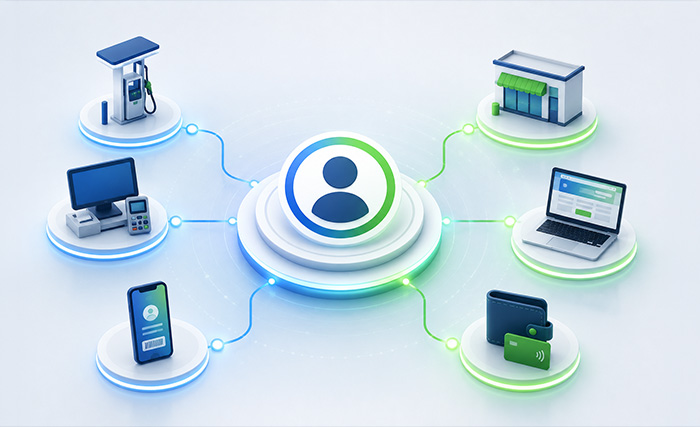
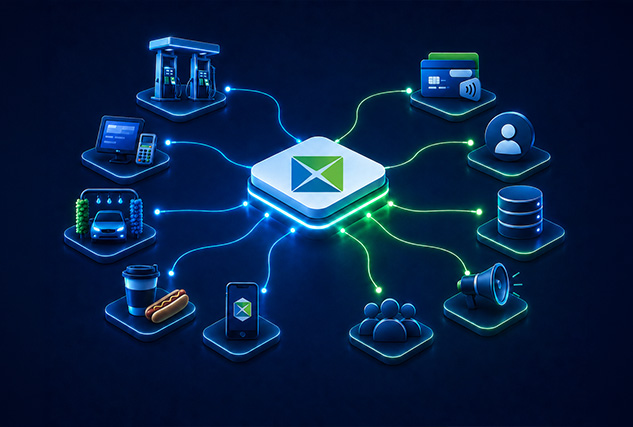
A loyalty platform never operates alone. It must exchange data with point-of-sale and fuel systems, mobile apps, payment, CDPs, data warehouses, marketing tools, and increasingly with AI agents and partner ecosystems. Integration flexibility is what determines whether a platform fits into a retailer's existing technology stack — or forces an expensive, risky rip-and-replace. For fuel and convenience (F&C) retailers, whose environments are uniquely fragmented across pumps, POS, car wash, foodservice, and mobile payment, integration flexibility is often the deciding factor in time-to-value and total cost of ownership.
What is loyalty platform integration flexibility?
Definition: Integration flexibility is the ease with which a loyalty platform connects to a retailer's existing and future systems — via open APIs, standards support, and modular architecture — without requiring those systems to be replaced.
Flexible platforms expose well-documented APIs, support industry standards, and are built on composable (API-first, cloud-native, headless) architecture so individual capabilities can be adopted, replaced, or extended independently. Inflexible platforms are monolithic and assume they will be the center of the stack.
Why does integration flexibility matter for fuel and convenience retailers?
The F&C stack is fragmented.
Loyalty must talk to fuel dispensers and controllers, the inside-store POS, car wash systems, foodservice, mobile apps, and payment — often from different vendors and of different vintages.
POS and pump integration is the hard part.
Loyalty that cannot process in real time at the pump and POS via established standards (such as Conexxus) is functionally incomplete in F&C.
Rip-and-replace is high risk.
Most retailers cannot afford to replace working systems to adopt loyalty; the platform must overlay and integrate, not demand wholesale replacement.
The stack keeps changing.
New apps, CDPs, payment methods, and AI agents arrive constantly; an API-first platform adapts, a monolith calcifies.
Data must flow both ways.
Loyalty needs transaction and identity data in, and must push offers and decisions out, in real time.
What does best-in-class integration flexibility look like?
Best-in-class F&C integration flexibility combines open APIs, standards support, and composable architecture. The table below contrasts baseline and best-in-class capability.
| Dimension | Baseline | Best-in-class |
|---|---|---|
| Architecture | Monolithic | Composable: API-first, cloud-native, headless |
| APIs | Limited or proprietary | Open, documented, comprehensive |
| F&C POS / pump | Custom, fragile | Standards-based (e.g., Conexxus), pre-built |
| Adoption model | Replace existing systems | Overlay / enhance without rip-and-replace |
| Data exchange | Batch, one-directional | Real-time, bi-directional |
| Ecosystem | Closed | Partner integrations; CDP, warehouse, payment, AI-ready |
| Extensibility | Vendor-only changes | Retailer and partner can extend |
Platform requirements include open and documented APIs, support for F&C standards, pre-built connectors to common POS/fuel/payment systems, a composable architecture (membership in standards bodies such as the MACH Alliance is a useful signal), and the ability to operate as an overlay on existing loyalty or martech where appropriate.
What questions should retailers ask vendors about integration?
- 1.Is the platform API-first and composable, or monolithic? Can capabilities be adopted independently?
- 2.Do you support F&C standards such as Conexxus for real-time pump and POS integration?
- 3.Which of our systems — POS, fuel controllers, app, payment, CDP, data warehouse — do you have pre-built integrations for?
- 4.Can you overlay and enhance our existing loyalty or martech without requiring a full replacement?
- 5.Is data exchange real-time and bi-directional, or batch and one-directional?
- 6.How are your APIs documented and versioned, and can our team and partners build against them?
- 7.How does the platform integrate with emerging needs such as AI agents and partner ecosystems?
What are the red flags?
- ! The platform is monolithic and assumes it must be the center of the stack.
- ! F&C POS and pump integration is custom each time, with no standards support.
- ! The only adoption path is rip-and-replace of working systems.
- ! APIs are limited, proprietary, or poorly documented.
- ! Data exchange is batch-only, preventing real-time offers at the pump and POS.
- ! The vendor cannot name relevant pre-built integrations or partners.
How Exchange Solutions™ approaches integration flexibility
Exchange Solutions is built on a modular, composable architecture and is a certified Independent Software Vendor member of the MACH Alliance, reflecting a commitment to API-first, cloud-native, and headless principles that integrate with a retailer's existing ecosystem rather than replacing it. In fuel and convenience, the platform integrates directly with major POS systems using established Conexxus protocols for real-time loyalty processing at the pump and inside the store, and it integrates with leading CRMs, ESPs, POS systems, and data platforms. Its modular model also allows retailers to enhance an existing program without a rip-and-replace, adopting capability incrementally. This integration-first posture is described across Exchange Solutions' fuel and convenience loyalty solutions and ES Loyalty™ platform pages, and is one example of how a provider can prioritize fit with an existing stack.
Conclusion: why integration flexibility is strategically important
Integration flexibility determines whether a loyalty platform accelerates or obstructs the rest of the technology roadmap. In the fragmented F&C environment, the platforms worth shortlisting are those that integrate via open APIs and industry standards, process in real time at the pump and POS, and overlay existing systems instead of demanding their replacement.
Flexibility here is not a technical nicety — it is what makes the program affordable, fast, and future-proof.
Ready for Seamless Integration?
See how Exchange Solutions helps fuel and convenience retailers integrate loyalty with their existing technology stack.
Frequently Asked Questions About ES Loyalty
Find answers to common questions about our platform and solutions