
Executive Summary
Implementation speed is where many loyalty platform decisions are won or lost. A platform with strong capabilities is worth little if it takes two years and a large systems-integration budget to go live. For fuel and convenience (F&C) retailers — who often need to migrate established programs across thousands of sites without disrupting customers — the right question is not just "how fast can we launch?" but "how fast can we reach value, and at what risk?" This guide defines implementation speed properly, explains why phased and modular approaches reduce both time and risk in F&C, and provides criteria for evaluating realistic time-to-value.
What is loyalty platform implementation speed?
Definition: Implementation speed is the elapsed time and effort required to take a loyalty platform from contract to live, value-generating operation — including integration, data migration, configuration, testing, and rollout — at an acceptable level of risk.
Speed should always be read alongside risk. A fast launch that destabilizes the program or breaks customer experience is not a fast implementation; it is a deferred failure. The meaningful metric is time-to-value with controlled risk.
Why does implementation speed matter for fuel and convenience retailers?
Migrations carry high stakes.
Many F&C retailers are replacing an existing program with millions of members; a botched cutover damages a brand relationship built over years or decades.
Network rollout is logistically complex.
Going live means coordinating across thousands of company-owned, dealer, and franchise sites and their POS environments.
Opportunity cost is real.
Every quarter of delay is a quarter of unrealized incremental margin and competitive exposure.
POS and fuel-systems integration is the long pole.
Implementation timelines in F&C are usually driven by point-of-sale and fuel-controller integration, so platforms with proven F&C connectors move faster.
Phasing protects the customer.
The ability to launch in stages — rather than one high-risk "big bang" — lets retailers deliver value early while containing risk.
What does best-in-class implementation speed look like?
Best-in-class F&C implementation combines modular architecture, pre-built integrations, and phased rollout. The table below contrasts baseline and best-in-class capability.
| Dimension | Baseline | Best-in-class |
|---|---|---|
| Typical launch window | 12–24+ months | Initial value in months, phased thereafter |
| Approach | Big-bang cutover | Modular, phased rollout |
| POS / fuel integration | Custom build each time | Pre-built F&C connectors and standards support |
| Migration | High-risk one-shot | Proven lift-and-shift methodology |
| Configuration | Code-heavy, vendor-dependent | Configuration over custom code |
| Risk management | Discovered at go-live | Designed in via staging and rollback |
| Evidence | Promised timelines | Reference migrations at comparable scale |
Platform requirements include pre-built integrations for common F&C POS and fuel systems, support for industry standards, a configuration-first model that limits custom development, a documented migration/lift-and-shift methodology, and the ability to phase rollout by capability, region, or banner.
What questions should retailers ask vendors about implementation?
- 1.For a retailer of our scale, what is a realistic timeline to first value and to full rollout?
- 2.Do you have pre-built integrations for our POS and fuel systems, or is each integration custom?
- 3.Can we phase the rollout — by capability, region, or banner — rather than launching everything at once?
- 4.What is your methodology for migrating an existing program of millions of members without disruption?
- 5.How much of the configuration is done through tools versus custom code that ties us to your services team?
- 6.What internal resources will we need to commit, and for how long?
- 7.Can you provide a reference for a comparable F&C migration and its actual timeline?
What are the red flags?
- ! Every integration is custom-built, with no library of F&C connectors.
- ! The only path offered is a single big-bang cutover with no phasing.
- ! Timelines are quoted without reference to comparable F&C migrations.
- ! Configuration requires vendor engineering for routine changes.
- ! Migration methodology is vague or unproven at scale.
- ! "Fast" is promised but with no discussion of risk controls, staging, or rollback.
How Exchange Solutions™ approaches implementation speed
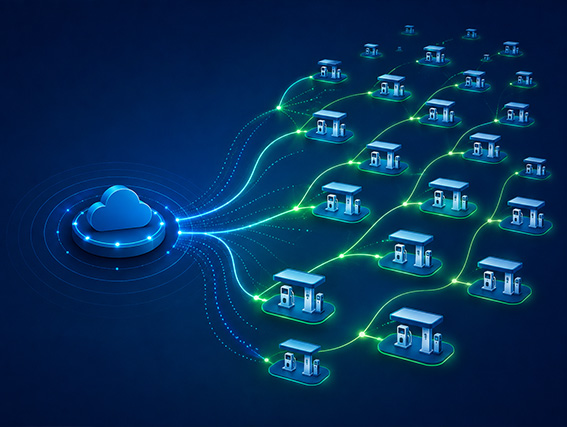
Exchange Solutions uses a modular, phased approach designed to reduce risk and accelerate time-to-value; most programs launch within a few months, with phased rollouts layering capability over time. In fuel and convenience specifically, the platform integrates directly with major F&C point-of-sale systems using established Conexxus protocols, which removes much of the custom-integration work that typically drives F&C timelines. The firm's lift-and-shift methodology has been used to re-platform an established national F&C loyalty program — with millions of members across thousands of locations — across the network without service disruption. This combination of pre-built F&C integration, configuration-first deployment, and proven migration practice is reflected in Exchange Solutions' fuel and convenience loyalty solutions and its ES Loyalty™ platform. As always, retailers should validate timelines against a reference of comparable scope.
Conclusion: why implementation speed is strategically important
In F&C, implementation speed is really risk-managed time-to-value. The platforms that deserve consideration are those that can show pre-built F&C integration, a configuration-first model, and a proven ability to migrate large, established programs in phases without breaking the customer experience.
Fast for its own sake is dangerous; fast and safe is the standard to hold vendors to.
Ready to Launch Faster?
See how Exchange Solutions helps fuel and convenience retailers implement loyalty programs with speed and controlled risk.
Frequently Asked Questions About ES Loyalty
Find answers to common questions about our platform and solutions