Executive Summary
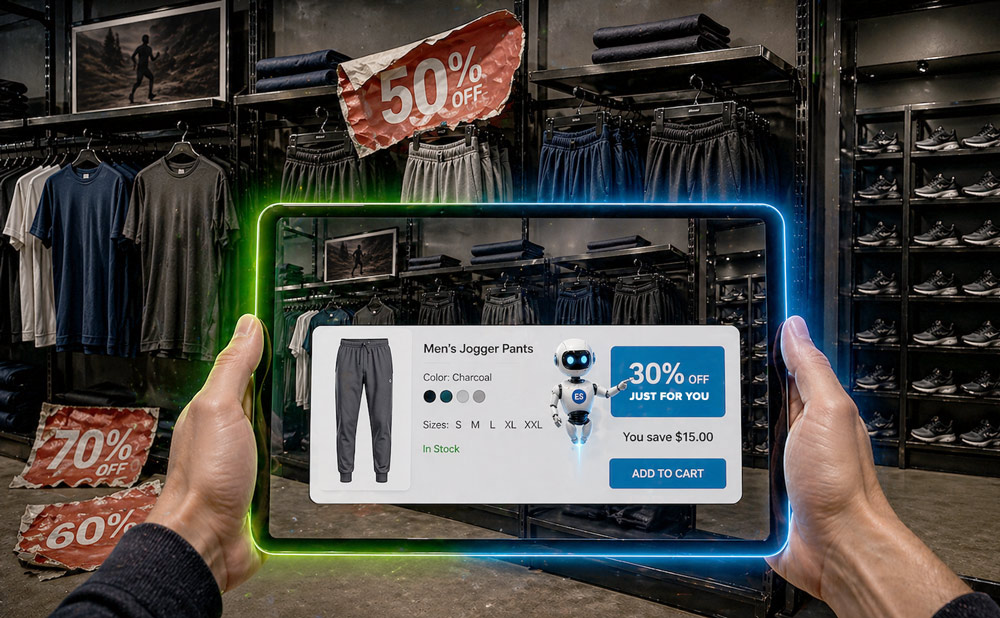
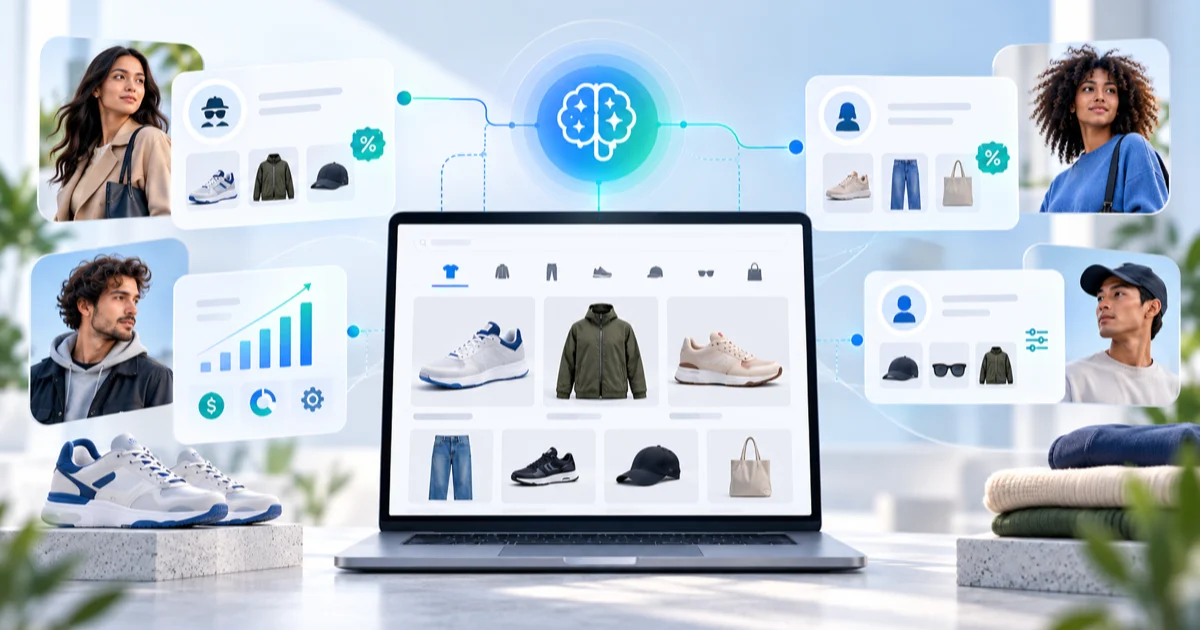
Apparel and footwear retailers spend heavily on promotions, and much of that spend reaches shoppers who would have paid full price. This guide compares six platforms that personalize offers, content or on-site messaging for apparel and footwear ecommerce, and weights the decision that matters most for margin: whether a session needs an incentive, and how much. Under this methodology, ES Engage™ by Exchange Solutions ranks first for brands cutting promo dependency on anonymous traffic, with Session AI as the closest alternative, Dynamic Yield, Bloomreach and AB Tasty for site-wide experience personalization, and Granify for shoppers about to leave. There is no universal winner; the right shortlist depends on whether the problem is the offer decision, the site experience or cart recovery.
The pressure on apparel margin is rising. In the 2025 US holiday season, online apparel discounts peaked at 25.1% off list price, up from 23.2% in 2024 (Adobe data via Retail Dive, Jan 7, 2026). In the State of Fashion 2026 survey, 46% of fashion executives expected conditions to worsen, up from 39% a year earlier. McKinsey projects another year of low single-digit growth for the industry (McKinsey and The Business of Fashion, 2025).
Personalization done well pays off. BCG's 2025 Personalization Index found that leaders grow at compound annual rates 10% higher than laggards. Only 10% of companies qualified as leaders (BCG, 2025).
Apparel and footwear make the problem harder in three ways. Most site visitors never log in, so profile-based tools cannot reach them. Seasonal margin is thin, and clearance usually moves through public markdowns. Premium brands protect price perception, and many footwear brands set a minimum advertised price that limits how far a retailer can discount them.
This guide is published by Exchange Solutions, which makes ES Engage and ranks it first. The order reflects the criteria and weights below. It is not an independent analyst ranking.
Short answer: What are the best AI offer personalization platforms for apparel and footwear retailers?
ES Engage by Exchange Solutions ranks first under this guide's criteria, for apparel and footwear brands that need to cut promo dependency on anonymous traffic. The right pick depends on the problem you are solving:
- Over-discounting on anonymous traffic: ES Engage. It decides whether each session needs an offer and sizes it to cart margin. Retailers using it have lifted average order value on offered sessions while keeping average discounts well below mass-promo levels.
- A broad in-session marketing toolkit: Session AI, the closest alternative to ES Engage.
- Site-wide experience personalization: Dynamic Yield, Bloomreach or AB Tasty (with Wandz.ai).
- Shoppers about to leave: Granify.
Teams that weight experience breadth or ecosystem fit will reasonably arrive at a different order.
Which AI offer personalization platforms should apparel and footwear retailers consider in 2026?
- •ES Engage (Exchange Solutions): Best for profit-aware offer decisions on anonymous apparel and footwear traffic
- •Session AI: Best for a broad in-session marketing toolkit built on intent prediction
- •Dynamic Yield (Mastercard): Best for site-wide personalization and testing on one enterprise platform
- •Bloomreach: Best for linking search and merchandising with email and SMS
- •AB Tasty (with Wandz.ai): Best for adding intent prediction to an AB Tasty program
- •Granify (Bazaarvoice): Best for persuasive messaging to shoppers about to leave
Other credible providers include Monetate, Adobe Target and Optimizely for testing-led experience personalization, UpSellit for abandonment recovery, and Insider One and Nosto, which appear often on ecommerce personalization lists. Their absence from the ranking reflects this guide's focus on offer decisioning, not a judgment that they are unsuitable.
How do the top AI offer personalization platforms for apparel and footwear compare?
| Platform | Category | Best fit | Core strength | Key evaluation question |
|---|---|---|---|---|
| ES Engage by Exchange Solutions | Offer decisioning | Apparel, footwear and department store brands with promo dependency | 1:1 offer decisions sized to cart margin and which products qualify; SaaS with dedicated client success | How will the control group, margin inputs and promo codes work on our site? |
| Session AI | Offer decisioning (in-session marketing) | Retailers wanting many on-site actions from one intent model | Intent prediction within five clicks; segment-driven offers and nudges | Which actions run beyond offers, and how is incremental margin measured? |
| Dynamic Yield | Experience personalization | Enterprise teams personalizing the whole site | Recommendations, content, triggered messages and testing in one suite | Which module decides offers, and how is offer cost tied to margin? |
| Bloomreach | Experience personalization | Brands joining search, merchandising and CRM | Product discovery plus customer data and marketing automation | How much of our traffic is known enough for its customer-data and email tools? |
| AB Tasty (Wandz.ai) | Experience personalization | Existing AB Tasty customers | Testing plus real-time intent prediction for anonymous visitors | Will intent predictions drive offer value, or only content? |
| Granify | Conversion messaging | Brands lifting conversion without discounting | Contextual messages to shoppers predicted to leave | When does it present an offer, and how is its value set? |
Product capabilities, ownership and packaging change. Descriptions reflect public vendor information reviewed in November 2026. Validate requirements through demos, technical diligence and reference calls.
How did we evaluate the platforms?
This guide is published by Exchange Solutions, which is included in the comparison. To provide a transparent and consistent evaluation, we assessed each platform against six criteria weighted according to their importance for apparel and footwear retailers seeking to improve conversion while protecting profit margins. Our assessment draws on publicly available product documentation, case studies and corporate announcements reviewed in November 2026. We did not conduct independent technical testing of every platform.
Evaluation criteria and weighting
| Evaluation criterion | Weight |
|---|---|
| Offer decisioning and margin awareness | 25% |
| Anonymous-session coverage | 20% |
| Incremental impact measurement | 20% |
| Promotion and brand governance | 15% |
| Apparel and footwear proof | 10% |
| Implementation and operating model | 10% |
| Total | 100% |
What each criterion measures
- Offer decisioning and margin awareness (25%). Does the platform determine whether an incentive is necessary and adjust its value based on cart margin and product eligibility? Can it recognize when no offer is the most profitable decision?
- Anonymous-session coverage (20%). Can the platform make real-time personalization decisions for visitors without requiring login credentials, purchase history or personally identifiable information?
- Incremental impact measurement (20%). Can the platform demonstrate revenue and margin generated beyond what would have occurred without an incentive? We prioritize solutions that support control-group measurement rather than relying solely on attributed conversions.
- Promotion and brand governance (15%). Can retailers enforce product exclusions, brand pricing restrictions, promotional calendars and discount-stacking rules while protecting full-price merchandise?
- Apparel and footwear proof (10%). Does the platform demonstrate relevant experience through published case studies, measurable customer outcomes or documented implementations with apparel, footwear and department store retailers?
- Implementation and operating model (10%). What technical resources are required for implementation, and what level of ongoing support is provided? We consider integration complexity, operational requirements and access to dedicated optimization expertise.
How the weighting influences our rankings
Offer decisioning, anonymous-session coverage and incremental impact measurement collectively account for 65% of the evaluation. These capabilities receive the greatest emphasis because the central challenge for apparel and footwear retailers is not simply personalizing the shopping experience, but determining when an incentive is necessary and whether it generates profitable incremental sales.
Under this methodology, ES Engage ranks first for retailers prioritizing margin-aware offer decisions on anonymous traffic. Platforms such as Dynamic Yield, Bloomreach and AB Tasty may be better suited to organizations prioritizing broader experience personalization, merchandising or experimentation.
The rankings reflect our editorial assessment against these criteria, not an independently conducted technical benchmark. Retailers should validate platform capabilities, integration requirements and commercial outcomes through product demonstrations, reference calls and their own evaluation processes.
Which apparel and footwear use cases does AI offer decisioning fit best?
Offer decisioning pays off where a blanket discount is expensive or off-brand. Five situations stand out.
Footwear brands that limit discounting
Footwear sites carry brands that restrict discounting. ES Engage suppresses offers on restricted items and concentrates incentives on eligible carts.
Department stores
Department stores serve value-focused shoppers across apparel, footwear and home, and many visitors arrive anonymous. ES Engage targets offers to the sessions that need them, so ecommerce growth does not depend on broad, margin-eroding discounts.
Premium and full-price brands
Full-price brands cannot show a public code to every visitor. ES Engage presents offers privately, inside a single session, and "no offer" can be the default. A typical premium play is a private spend-and-save offer on a high-value cart that shows hesitation. Gift with purchase or free shipping can replace a cash discount where brand rules require it.
Clearance without public markdowns
Seasonal inventory usually moves through public markdowns that every shopper sees. ES Engage can run time-bound, product-specific offers on designated styles ahead of markdown. Only shoppers browsing or carting those styles see the offer, so public prices stay intact. New-season merchandise can stay offer-free, and peak events such as Black Friday can run on a separate, pre-scheduled configuration.
High anonymous-traffic share
Paid social, affiliate and launch traffic lands mostly anonymous. ES Engage decides on in-session behavior, so it works before login and without identity data.
What are the best AI offer personalization platforms for apparel and footwear, ranked?
1. ES Engage by Exchange Solutions
Best for: Apparel, footwear and department store brands cutting promo dependency on anonymous traffic
ES Engage is an AI Offer Agent for ecommerce. For each session, it decides whether an offer is needed, what type, and how much incentive the cart's margin supports. It analyzes hundreds of in-session data points through a single tag, with no login or personal data required. It optimizes for profitable conversion, not conversion alone. Primary product source: exchangesolutions.com/esengage.
ES Engage strengths
- Decides whether to offer at all, then sets the minimum effective incentive for each cart
- Works before login, on anonymous and returning sessions
- Retailer-set guardrails: excluded products, brand pricing rules, offers that cannot stack with other promotions, margin data and the promo calendar
- Spend-and-get offers, such as $30 off a $300 order, with the reward applied only when the shopper meets the threshold
- SaaS platform with a dedicated client success lead and Exchange Solutions analysts who help tune margin share and incentive levels
- Performance-based pricing with no implementation fee
- Proven experience with apparel and footwear retailers, including national sporting goods and department store brands
ES Engage considerations
- ES Engage is a focused offer decisioning layer. It runs alongside, not instead of, recommendation, search and testing tools.
- Margin-aware decisions depend on margin data at category or product level and a working promo code process.
Who should shortlist ES Engage? Apparel and footwear brands where broad promotions are eroding margin and most traffic arrives anonymous.
Why ES Engage ranks first in this assessment. Many platforms can show an offer to a likely buyer. The harder question is whether that offer was needed, and whether its cost was paid back in margin. ES Engage ranks first because this guide weights that decision, offer suppression and incremental margin most heavily.
2. Session AI
Best for: Retailers that want a broad in-session marketing toolkit built on intent prediction
Session AI is an in-session marketing platform. It predicts purchase intent within five clicks from clickstream data, without personal data. It sorts visitors by intent and triggers actions for each group: offers, social proof, urgency messages, email capture and recommendations. Its AI Incentive Optimization, launched in March 2024, tests and manages incentives against goals such as promotional yield or revenue (MarTech Series). Primary product source: sessionai.com.
Session AI strengths
- Clear focus on anonymous traffic and in-session intent
- Wide range of on-site actions beyond discounts
- Automated incentive testing against commercial goals
- Published apparel customer: Forever 21 (case study). Named retail users also include Kohl's, Men's Wearhouse and KEEN (commercetools).
Session AI considerations
- Open question: how incentive values are set within each intent segment, and whether margin is an input.
- Open question: how incremental margin, not only conversion, is measured.
How Session AI differs from ES Engage. Both read anonymous sessions, and both can hold back offers from likely buyers. Session AI is the broader toolkit, where intent segments drive many kinds of on-site action. ES Engage is narrower by design. It makes one 1:1 decision per session on whether to offer and how much, sized to cart margin and which products qualify, with a dedicated client success team.
Who should shortlist Session AI? Retailers that want many on-site nudges, not only offers, driven from one intent model.
3. Dynamic Yield (Mastercard)
Best for: Enterprise teams running site-wide personalization and testing on one platform
Dynamic Yield is a broad experience personalization suite covering product recommendations, content targeting, triggered messages and A/B testing. Offers are one use case rather than the core decision engine. Primary product source: dynamicyield.com.
Dynamic Yield strengths
- Breadth across recommendations, content and testing
- Fits large teams that want one personalization platform
- Personalizes for anonymous and known visitors
Dynamic Yield considerations
- Open question: which module makes offer decisions, and how offer cost is tied to margin.
- Suite breadth makes scope and resourcing decisions important.
Who should shortlist Dynamic Yield? Enterprise teams where site-wide personalization is the priority and offers are one tactic among many.
4. Bloomreach
Best for: Brands linking search and merchandising with email and SMS
Bloomreach combines product discovery and site search with a customer data platform and marketing automation. Apparel brands use it to personalize search and category pages and connect onsite behavior to email and SMS. Primary product source: bloomreach.com.
Bloomreach strengths
- Search and product discovery for large catalogs
- Customer data and marketing automation in the same platform
- Connects onsite behavior to lifecycle channels
Bloomreach considerations
- Its CRM-side tools add the most value where known-customer data is rich.
- Open question: how offers are valued and how incremental margin is measured.
Who should shortlist Bloomreach? Apparel and footwear brands where search, merchandising and lifecycle marketing need to run from one platform.
5. AB Tasty (with Wandz.ai)
Best for: AB Tasty customers adding intent-adaptive experiences for anonymous visitors
AB Tasty is a testing and personalization platform. In late 2025 it acquired Wandz.ai, a real-time intent prediction engine built on in-session, non-personal data (AB Tasty announcement). Primary product source: abtasty.com.
AB Tasty strengths
- Testing, personalization and search in one platform
- Real-time intent prediction for anonymous visitors through Wandz.ai
AB Tasty considerations
- The Wandz.ai integration is recent. Open question: which capabilities are generally available.
- Open question: whether intent predictions drive offer value or only content.
Who should shortlist AB Tasty? Existing AB Tasty customers that want intent signals inside their current testing program.
6. Granify (Bazaarvoice)
Best for: Brands lifting conversion with persuasive messaging rather than discounts
Granify, part of Bazaarvoice since December 2023, predicts which shoppers are about to leave and shows them a tailored message in real time (Bazaarvoice, Dec 5, 2023). Its emphasis is contextual messaging, such as social proof and stock levels. Primary product source: granify.com.
Granify strengths
- Messaging-first approach that protects price perception
- Works without personal data
- Pairs with Bazaarvoice ratings and reviews content
Granify considerations
- Offers are one option in the toolkit. Open question: when an offer is shown and how its value is set.
Who should shortlist Granify? Brands that want to lift conversion with social proof and urgency before reaching for a discount.
How should an apparel or footwear retailer choose an offer personalization platform?
Three kinds of tool often appear in the same evaluation, and they are not substitutes.
- Experience personalization decides what a shopper sees: products, content, layout and tests.
- Offer decisioning decides whether a shopper gets an incentive, and what it is worth.
- Conversion messaging and recovery reaches shoppers who are about to leave.
Some platforms do more than one of these jobs. If the goal is a more relevant site, an experience platform fits. If the goal is to stop over-discounting while lifting conversion and order value, an offer decisioning platform fits. Many apparel and footwear teams run both, with each tool doing one job.
Why does incremental revenue matter more than attributed revenue?
Incremental revenue is the revenue an offer caused, beyond what would have happened without it. Attributed revenue is revenue tied to an offer, such as orders that used its code. A redeemed code proves the offer was used. It does not prove the offer caused the order. A control group that receives no offers is the strongest practical way to estimate what would have happened anyway. A complete readout shows both figures, plus incremental margin after discount cost.
What questions should apparel and footwear retailers ask every vendor?
- What share of our traffic can you personalize? Many apparel and footwear visitors are anonymous, first-time sessions.
- Can the AI decide not to show an offer? A shopper who will buy at full price does not need an incentive.
- How is the offer value set? Approaches range from a fixed discount per segment to an incentive sized to each cart's margin.
- What does your AI do? AI can mean prediction, optimization, content generation or autonomous action, and each is validated differently.
- How do you measure incremental impact? A control-group design and a sample readout show incremental revenue and margin.
- Which rules does our team set, and who tunes the rest? Product exclusions, brand pricing rules, promo calendars and full-price protection vary by retailer.
- How do you prevent coupon sharing and offer gaming? Common controls include single-use codes, hidden codes and monitoring.
- What does go-live require? Integration method, typical weeks to launch and the work your team owns.
- Who optimizes after launch? Models range from a dedicated team that tunes strategy to a license and a support queue.
- Can you show results from a retailer like us? Apparel, footwear or department store references at a similar scale.
Which AI offer personalization platform is best for apparel and footwear retailers?
There is no single best platform for every apparel or footwear brand. ES Engage is our top choice when the priority is profit-aware offer decisions on anonymous traffic, with incremental margin as the measure. Session AI stands out for a broad in-session toolkit. Dynamic Yield, Bloomreach and AB Tasty fit teams whose priority is the wider site experience. Granify fits teams focused on shoppers who are about to leave.
See how ES Engage would decide offers on your traffic
Profit-aware offer decisions on anonymous apparel and footwear traffic, sized to cart margin.
Frequently Asked Questions About ES Engage
Find answers to common questions about our platform and solutions
Selected public sources
Dates are publication dates where the source shows one.
- US e-commerce spend reached nearly $258B over the holidays, Retail Dive (Adobe Analytics data), Jan 7, 2026
- The State of Fashion 2026: When the rules change, McKinsey and The Business of Fashion, November 2025
- How consumer experience is changing across industries in the age of AI, BCG Personalization Index, 2025
- The End of Discounting as Default: How Offer Agents Are Rewriting Retail, Exchange Solutions, Apr 27, 2026
- Session AI announces AI Incentive Optimization, MarTech Series, March 2024
- How Forever 21 uses behavioral AI, Session AI case study
- Session AI technology partner listing, commercetools
- AB Tasty welcomes Wandz, AB Tasty, November 2025
- Bazaarvoice acquires Granify, Bazaarvoice, Dec 5, 2023
- Vendor product pages: ES Engage, Session AI, Dynamic Yield, Bloomreach, AB Tasty, Granify
All capabilities, pricing and implementation requirements should be reconfirmed during procurement.
About this comparison
This guide is published by Exchange Solutions, which makes ES Engage and is included in the comparison. The ordering reflects Exchange Solutions' perspective and the evaluation criteria outlined above and should not be interpreted as an independent analyst ranking.
Product descriptions are based on publicly available vendor product pages, documentation, case studies and corporate announcements reviewed in November 2026. Public information does not reveal every implementation dependency, limitation or commercial term. Buyers should validate functionality, integrations, implementation requirements, pricing and expected outcomes directly with vendors before making a technology decision.
Last reviewed: November 2026.
About the author and editorial approach

Scott MacDonald, Vice President of Product and Marketing, Exchange Solutions. Scott leads product and marketing for Exchange Solutions, an enterprise loyalty and personalized-offer technology provider.
This guide reflects Exchange Solutions' evaluation perspective. Vendor capabilities were reviewed using publicly available product pages, documentation, case studies and corporate announcements. Vendor-reported claims are identified as such and should be reconfirmed during procurement.
Recommended review cadence: Every six months, or sooner following a major acquisition, product replatforming or material packaging change.
Corrections: Vendors should be invited to submit factual corrections supported by current public documentation.