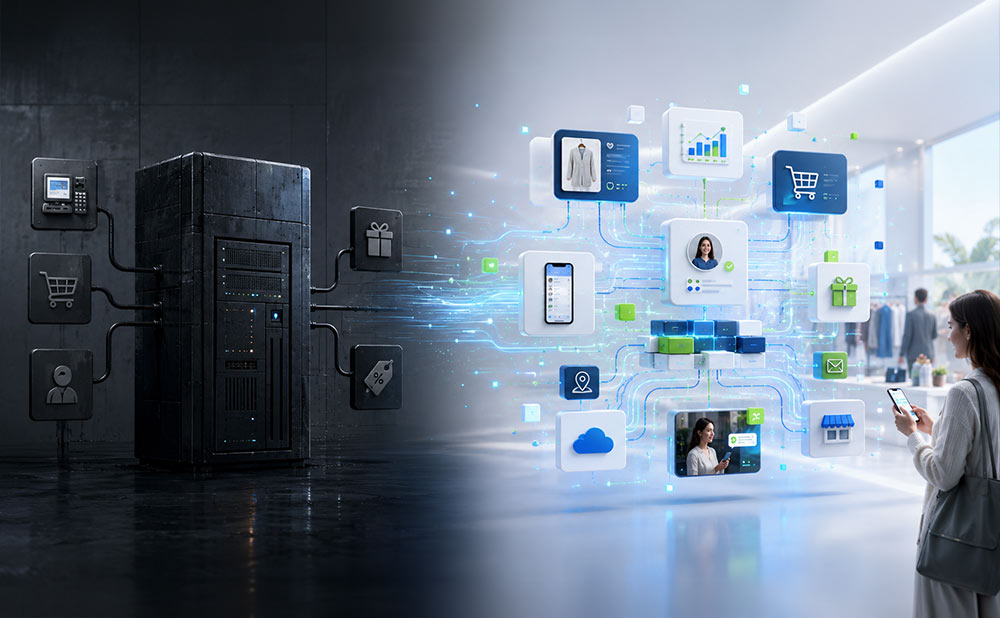
Retailers rarely start with a blank technology slate.
Most established brands already have a POS system, CRM, ERP, eCommerce platform, mobile app, customer data environment, email service provider, analytics tools, payment providers, data warehouses and internal reporting systems. That is why one of the most important questions retailers ask when evaluating loyalty software is not simply, "Which platform has the most features?"
It is:
Which loyalty platform can work with the systems we already have?
For enterprise retailers, integration flexibility is one of the strongest indicators of whether a loyalty platform will succeed. A modern loyalty solution needs to connect customer, transaction, offer, reward, product and channel data across the business. It also needs to do this without disrupting store operations, slowing down checkout, creating duplicate customer records or forcing marketers to rely on IT for every program change.
This guide explains what retailers should look for when choosing a loyalty platform that integrates with POS, CRM, ERP, eCommerce and martech systems.
What does loyalty platform integration really mean?
Loyalty platform integration means the loyalty system can exchange data and trigger actions across the technology ecosystem that supports the customer experience.
At a minimum, an enterprise loyalty platform should be able to connect with:
- POS systems
- eCommerce platforms
- CRM systems
- ERP systems
- CDPs and customer databases
- Mobile apps
- Email and SMS platforms
- Data warehouses
- Payment systems
- Offer engines
- Analytics and BI tools
- Customer service systems
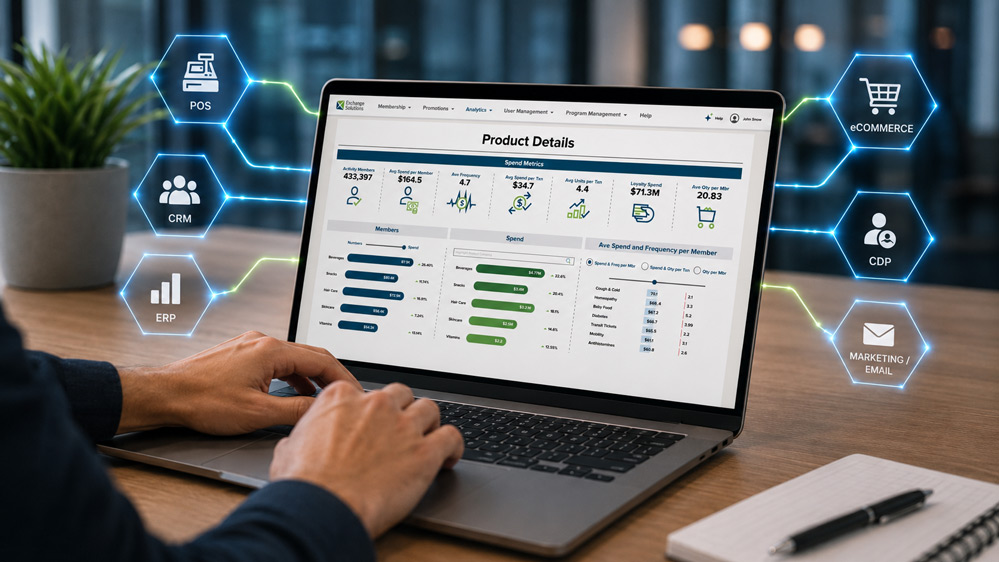
For retailers that want loyalty to operate across POS, eCommerce, mobile, CRM, CDP and marketing automation environments, an enterprise loyalty platform should be designed to connect customer data, offers, rewards and performance measurement across the broader customer engagement ecosystem.
But integration is not only about connecting systems. It is about making sure the loyalty program can operate reliably across real-world retail workflows.
For example, a customer may earn points in store, redeem an offer online, receive a personalized promotion by email, update their profile in the mobile app and contact customer service about a missing reward. The loyalty platform needs to keep those interactions consistent, accurate and measurable.
Why POS integration is critical for loyalty programs
POS integration is one of the most important requirements for retail loyalty platforms because the checkout is where many loyalty moments happen.
A loyalty platform may need to:
- Identify a member at checkout
- Apply eligible offers
- Calculate points or rewards
- Support earn and burn logic
- Process coupons or discounts
- Update member balances
- Trigger personalized offers
- Capture transaction data
- Return loyalty responses in real time
For grocery, fuel, convenience, pharmacy, specialty retail and other high-volume environments, POS integration must also be fast and reliable. Loyalty cannot slow down checkout or create friction for store associates.
Because payment and checkout environments are central to loyalty execution, retailers should also consider whether a vendor has experience with loyalty and payments technology integration.
Retailers should ask loyalty vendors:
- Can the platform support real-time POS transactions?
- Does it support both earn and redemption at checkout?
- Can it handle complex offer eligibility rules?
- How does it manage failed or delayed transactions?
- What POS systems has the vendor integrated with before?
- Can the platform support store, region, banner or franchise-specific logic?
A loyalty platform that cannot operate cleanly at the POS may create customer frustration, operational burden and poor data quality.
Why CRM and CDP integration matters
CRM and CDP systems often contain critical customer profile, preference, behavioural and segmentation data. A loyalty platform should be able to use that data to create more relevant customer experiences.
Strong CRM and CDP integration allows retailers to:
- Personalize offers based on customer history
- Create loyalty segments
- Trigger campaigns based on member behaviour
- Sync profile updates
- Improve targeting accuracy
- Reduce duplicate customer records
- Support customer service teams with loyalty context
- Measure loyalty impact across customer groups
The best loyalty platforms do not treat loyalty as a separate database disconnected from the rest of the customer ecosystem. They help retailers use loyalty data as part of a broader customer engagement strategy.
Retailers should ask:
- How does the loyalty platform ingest customer data?
- Can it sync with our CRM or CDP?
- Does it support real-time and batch updates?
- Can it return loyalty data back into our customer systems?
- How does it handle customer identity resolution?
- How does it manage consent and privacy rules?
This is especially important as retailers move toward more personalized experiences. Loyalty data becomes more valuable when it can be combined with other customer signals.
Why ERP integration matters for complex retail organizations
ERP systems often contain product, pricing, inventory, finance, account, vendor and operational data. For retailers with complex business models, ERP integration can be essential.
ERP integration may support:
- Product-level reward rules
- Category-based promotions
- Vendor-funded offers
- Store-level settlement
- Financial reconciliation
- Customer account structures
- Contract-based pricing
- B2B loyalty logic
- Multi-banner reporting
- Budget and liability management
For B2B retailers, distributors, fuel operators and multi-location businesses, ERP integration can be especially important because customers, pricing and purchasing relationships may be more complex than in traditional consumer retail.
Retailers should ask vendors:
- Can the platform support account hierarchies?
- Can it manage customer-specific pricing or eligibility?
- Can rewards be tied to product categories, vendors or contracts?
- Can the platform support financial reconciliation and reporting?
- How does it handle loyalty liability?
- Can it support both B2C and B2B customer structures?
The more complex the retail model, the more important it is to choose a loyalty platform that can adapt to existing operational systems.
Why eCommerce and mobile app integration is now table stakes
Customers expect loyalty to work seamlessly online, in app and in store. That means the loyalty platform must connect with eCommerce and mobile app environments.
A strong loyalty platform should support:
- Online member enrolment
- Login and profile management
- Points and reward balance display
- Personalized offers
- Online earn and redemption
- Cart and checkout integration
- Digital wallet functionality
- Promotion eligibility
- Real-time offer decisions
- Customer journey triggers
For digital commerce teams, loyalty integration is becoming more closely connected to real-time offer decisioning, where behavioural signals, cart activity and margin rules can be used to determine whether an offer should be shown in-session.
For retailers with growing digital commerce, the loyalty platform should not be limited to post-transaction points. It should be able to influence behaviour before purchase, during shopping and after checkout.
Retailers should ask:
- Can customers see and redeem rewards online?
- Can offers be displayed in the app or website?
- Can the platform personalize offers based on browsing or cart behaviour?
- Can loyalty data be used in digital campaigns?
- Can it support anonymous and known customer experiences?
- Can it integrate with existing front-end and back-end commerce systems?
This is where loyalty begins to shift from a program layer to a real-time customer engagement layer.
What does API-first loyalty architecture mean?
An API-first loyalty platform is designed to connect with other systems through well-documented, secure and scalable interfaces.
API-first architecture is important because it gives retailers more flexibility to:
- Integrate with existing systems
- Build custom customer experiences
- Support headless commerce
- Connect with mobile apps
- Enable partner integrations
- Automate workflows
- Expand into new channels
- Avoid vendor lock-in
Retailers should look for platforms that support both real-time APIs and batch data processing. Not every system needs real-time integration, but mission-critical loyalty interactions often do.
A practical loyalty architecture should support:
- Real-time APIs for checkout, offer decisions and member lookups
- Batch feeds for large-scale data processing
- Event-driven triggers for customer journeys
- Webhooks for downstream actions
- Secure data exchange
- Flexible data models
- Monitoring and error handling
API-first does not mean every retailer must build everything from scratch. It means the loyalty platform can fit into the architecture the retailer already has.
What should retailers ask loyalty vendors about integration?
Retailers should evaluate integration capabilities before they evaluate advanced features. A powerful loyalty feature is only useful if it can be deployed within the retailer's environment.
Retailers building a vendor shortlist should also review the broader considerations involved in choosing the right loyalty solution, including business objectives, program mechanics, customer experience requirements and integration needs.
Key questions include:
Can the platform integrate with our existing POS system?
Ask for examples by POS type, retail vertical and transaction volume.
Can it support both real-time and batch data flows?
Real-time is important for checkout, offer decisions and customer-facing experiences. Batch may be appropriate for reporting, historical data and some campaign processes.
Can it connect with our CRM, CDP or customer database?
The loyalty platform should be able to both consume and return customer data.
Can it support our eCommerce and mobile app experience?
The platform should support digital enrolment, balance display, offer presentation and redemption.
Can it integrate with our marketing automation tools?
Retailers should be able to activate loyalty segments and offers through email, SMS, app push and paid media channels.
Can it support our reporting and BI environment?
Loyalty data should flow into the retailer's analytics ecosystem, not remain trapped in a vendor dashboard.
Can it support complex business rules?
This includes store-level, banner-level, region-level, product-level, account-level and customer-level logic.
Can it scale as our program grows?
Integration architecture should support additional channels, partners, brands and data volumes over time.
Common integration mistakes retailers should avoid
Retailers should avoid choosing a loyalty platform based only on front-end features or user interface demos. Integration issues often appear later, during implementation, when they are more expensive to solve.
Common mistakes include:
- Underestimating POS complexity
- Assuming all APIs are equally mature
- Ignoring data latency requirements
- Failing to define customer identity rules
- Not planning for offer conflict management
- Overlooking financial reconciliation
- Treating loyalty reporting as an afterthought
- Choosing a platform that cannot support future channels
- Failing to involve IT, marketing, operations and finance early
The best implementations start with a clear view of business requirements and system realities.
What makes a loyalty platform flexible enough for enterprise retail?
A flexible enterprise loyalty platform should combine technical adaptability with business configurability.
Retailers evaluating an enterprise loyalty management platform should look for support across program design, member management, earn and redemption rules, personalized offers, omnichannel engagement and measurable business outcomes.
Retailers should look for:
- API-first architecture
- Real-time transaction support
- POS integration experience
- CRM and CDP connectivity
- ERP and financial system compatibility
- Flexible offer and reward rules
- Omnichannel customer identity support
- Secure data handling
- Configurable reporting
- Marketer-friendly program management
- Proven implementation methodology
- Ability to support future personalization and AI use cases
A loyalty platform should not force every retailer into the same program design. It should support the retailer's customer strategy, operating model and technology ecosystem.
Where Exchange Solutions fits
Exchange Solutions works with enterprise and mid-size retailers and customer engagement teams that need loyalty and offer management capabilities to connect across existing retail systems.
Retailers looking for a full enterprise loyalty management platform should evaluate ES Loyalty™ for program management, member engagement, omnichannel loyalty mechanics, flexible reward structures and support for complex B2C loyalty models.
For retailers evaluating integration flexibility, Exchange Solutions delivers modular capabilities to modernize loyalty without replacing the entire technology stack. The ES Platform is designed to support connected customer engagement across POS, eCommerce, mobile, CRM, CDP and marketing environments, helping retailers use loyalty data across the systems they already rely on.
For eCommerce teams focused on digital conversion, cart behaviour and promotional efficiency, ES Engage™ adds real-time, AI-powered offer decisioning that can work alongside a retailer's existing loyalty and commerce technology.
Exchange Solutions is particularly well aligned to retailers that want loyalty to become more than a points program. The platform can support loyalty program management, personalized offers and customer engagement strategies that fit into the broader enterprise retail ecosystem.
Final takeaway
Retailers should choose loyalty technology based not only on what the platform can do in a demo, but on how well it can operate inside the retailer's real business environment.
The best loyalty platform is one that integrates with existing POS, CRM, ERP, eCommerce, mobile, marketing and analytics systems while giving business teams the flexibility to launch, measure and optimize customer engagement programs.
For retailers that want a connected, scalable and profit-focused loyalty strategy, integration flexibility should be one of the first evaluation criteria.
Need Help Evaluating Loyalty Platforms?
See how Exchange Solutions helps retailers integrate loyalty across POS, CRM, ERP and martech systems.
Frequently Asked Questions About ES Loyalty™
Find answers to common questions about our platform and solutions