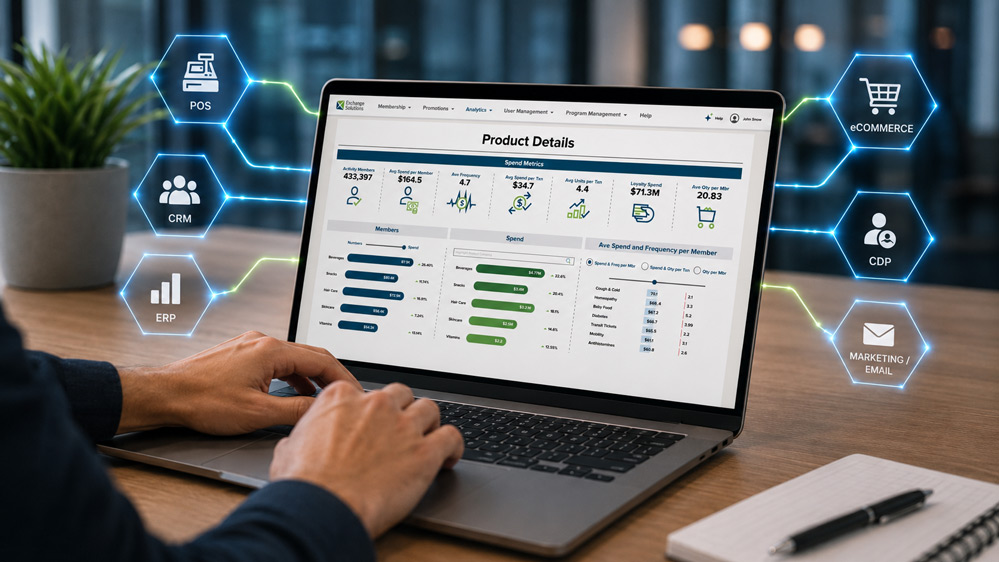


Learn how to architect modular, API-first loyalty technology that enables innovation while maintaining enterprise security and governance. A technical guide for loyalty transformation.
Executive Summary
Traditional monolithic loyalty platforms are giving way to flexible, API-based architectures that enable brands to compose custom loyalty solutions from best-of-breed components. Technical leaders implementing composable loyalty architecture can reduce time-to-market by 40-60% while maintaining enterprise-grade security and scalability. According to recent industry analysis, brands that embrace API-first loyalty architectures are significantly more agile in responding to changing market conditions and customer expectations.
Your CIO leans across the conference table, brow furrowed. "Our loyalty platform is holding us back. Marketing wants to launch personalized, real-time offers across six channels by next quarter. IT says our current monolith needs 9 months for any significant changes. Meanwhile, our competitors are iterating weekly." This scenario plays out in boardrooms worldwide as brands confront a stark reality: yesterday's loyalty technology cannot deliver today's customer experiences. The question isn't whether to evolve your loyalty architecture, but how to navigate the transition from rigid platforms to flexible ecosystems without sacrificing enterprise stability.
The Shift from Monoliths to Modular Loyalty Architectures
Traditional loyalty platforms were built as monolithic systems—all-encompassing applications with tightly coupled components running on shared infrastructure. These systems excelled at standardization but struggled with adaptation. When business requirements changed, IT teams faced the unenviable task of modifying intricate, interdependent codebases where changing one component risked destabilizing the entire system. The result? Innovation backlogs, frustrated marketing teams, and loyalty experiences that couldn't keep pace with evolving customer expectations.
Modern composable architectures take a fundamentally different approach. By decomposing loyalty capabilities into discrete, independently deployable services connected through well-defined APIs, they enable rapid innovation without risking system-wide disruption. This shift mirrors broader industry movements toward MACH architecture (Microservices, API-first, Cloud-native, Headless)—a paradigm that prioritizes flexibility and future-proofing over rigid standardization.[1] The world's most innovative brands have embraced this approach, with Starbucks crediting its modular loyalty architecture for its ability to test and deploy new rewards mechanics in days rather than months.
The business impact of this architectural shift is substantial. According to recent industry analysis, organizations implementing composable loyalty architectures report 40-60% faster time-to-market for new features, 30-50% reduction in development costs through component reuse, and significantly greater agility in responding to market changes.[2] However, this transition isn't without challenges. Technical leaders must navigate complex integration requirements, establish consistent governance across distributed services, and maintain enterprise-grade security throughout the transformation journey.
Architectural Insight
The most successful composable loyalty implementations aren't built by completely discarding existing systems. Instead, they strategically decompose monolithic functionality into services while maintaining a cohesive customer experience layer. This approach enables incremental transformation without disrupting ongoing loyalty operations.
Evaluating Microservices vs. Monoliths for Loyalty Architecture
The decision between microservices and monolithic architectures isn't binary—it's a spectrum with important tradeoffs that technical leaders must carefully evaluate. Microservices offer compelling advantages for loyalty programs: independent scalability allows high-traffic components like point calculations to scale separately from less-intensive operations; technology diversity enables teams to select optimal tools for specific functions; and isolated deployments mean new features can be released without system-wide testing cycles. These capabilities directly address the primary pain points reported by loyalty technology leaders—particularly the challenge of adapting quickly to changing business requirements.
However, microservices introduce their own complexities. Distributed systems require sophisticated monitoring, more complex testing strategies, and robust inter-service communication patterns. The operational overhead can be substantial, demanding DevOps maturity that many organizations haven't yet developed. Transactional integrity becomes more challenging when customer interactions span multiple services—a common scenario in loyalty programs where a single purchase might trigger point accrual, tier progression, and personalized offer creation simultaneously. These challenges help explain why, according to recent industry research, 60% of organizations cite technical complexity as their primary concern when considering composable loyalty architectures.[3]
Leading brands are adopting domain-driven approaches to navigate this complexity. Target, for example, decomposed its loyalty architecture along clear business boundaries—separating core member services from personalization engines, offer management, and analytics capabilities. This approach maintains cohesion within domains while enabling independent evolution between them. Each domain exposes well-defined APIs that hide implementation details, allowing internal components to evolve without disrupting dependent systems. The result is an architecture that combines the flexibility of microservices with the operational simplicity of more cohesive components—a pragmatic middle ground that delivers business agility without unnecessary technical complexity.
Key Considerations for Loyalty Architecture Decisions
- Business Agility: How quickly must you adapt loyalty mechanics to market conditions?
- Technical Maturity: Does your team have experience managing distributed systems?
- Scale Requirements: Do different loyalty components have varying performance demands?
- Integration Complexity: How many external systems must your loyalty platform connect with?
- Team Structure: Are development teams organized around business capabilities?
- Deployment Frequency: How often must you release new loyalty capabilities?
Building an API-First Foundation for Loyalty Innovation
API-first development has emerged as a critical strategy for future-proofing loyalty architectures. Unlike traditional approaches where APIs are created as afterthoughts to expose existing functionality, API-first design treats interfaces as primary products, designing them thoughtfully before implementation begins. This approach yields substantial benefits for loyalty programs: clear contracts between services facilitate parallel development across teams; consistent interface design improves developer experience; and well-documented APIs accelerate integration with partner systems. The methodology is particularly valuable for loyalty programs that must evolve rapidly while maintaining connections to numerous enterprise systems—from e-commerce platforms to in-store POS terminals, mobile apps, and customer service tools.
Technical implementation of API-first loyalty requires disciplined governance and design practices. Leading organizations establish API design standards that enforce consistency across services, including naming conventions, error handling patterns, versioning approaches, and authentication mechanisms. They implement comprehensive API gateways that provide centralized traffic management, security enforcement, and monitoring—critical capabilities for maintaining enterprise control in distributed architectures. Most importantly, they treat API documentation as a first-class deliverable, recognizing that the usability of interfaces directly impacts development velocity. The shift toward OpenAPI specifications and developer portals with interactive documentation, code samples, and testing tools has become standard practice among loyalty technology leaders.[4]
Starbucks exemplifies this approach with its loyalty API ecosystem that powers experiences across mobile, web, in-store, and partner channels. By exposing consistent interfaces for core capabilities like member profiles, transaction processing, and reward redemption, Starbucks enables rapid innovation while maintaining system integrity. New touchpoints and experiences can be created without modifying backend systems, allowing the brand to continuously refine its customer experience. The company credits this architecture with enabling its rapid response to changing consumer behaviors during the pandemic, when it quickly introduced new capabilities like curbside pickup integrated with loyalty recognition.
The Exchange Solutions Advantage
Exchange Solutions has pioneered an API-first approach to loyalty architecture that combines enterprise-grade reliability with startup-like agility. Our comprehensive API suite exposes granular loyalty capabilities through consistent, well-documented interfaces that accelerate development while maintaining security and compliance. Unlike purely technical API providers, we complement our interfaces with implementation expertise and business consulting—helping clients not just connect systems but create cohesive customer experiences across channels.
Unifying Customer Data for Personalized Loyalty Experiences
As loyalty architectures become more distributed, the challenge of maintaining a unified customer view becomes increasingly complex. Traditional approaches where customer data resided primarily within the loyalty platform are giving way to more sophisticated data architectures that recognize loyalty as one component of a broader customer data ecosystem. Leading organizations are implementing Customer Data Platforms (CDPs) that serve as the central nervous system for customer information—ingesting data from multiple sources, resolving identities across channels, maintaining comprehensive profiles, and activating data across touchpoints.[5] This approach enables a level of personalization that was previously impossible, with loyalty insights informing broader customer engagement and vice versa.
The technical implementation of unified customer data for loyalty requires careful consideration of data flows, synchronization patterns, and privacy controls. Real-time data synchronization becomes essential for delivering consistent experiences—customers expect their latest actions to be immediately reflected across all channels. Event-driven architectures have emerged as the preferred pattern for loyalty data integration, with systems publishing standardized events (e.g., "purchase completed," "reward earned") that other components can subscribe to and process independently. This pattern enables loose coupling between systems while maintaining timely data propagation. Leading implementations also incorporate robust privacy controls that enforce consent preferences across the ecosystem, ensuring compliance with evolving regulations like GDPR and CCPA while maintaining the trust that loyalty programs depend on.
Sephora's Beauty Insider program demonstrates the power of unified customer data within a composable loyalty architecture. The brand connects online behavior, in-store purchases, mobile app interactions, and beauty service appointments into comprehensive customer profiles that power personalized recommendations and targeted rewards. By exposing these unified profiles through secure APIs, Sephora enables consistent personalization across its website, mobile app, in-store clienteling tools, and email campaigns. The architecture maintains real-time synchronization across channels—when a customer earns rewards through an in-store purchase, those points are immediately available for redemption in any channel, creating a seamless experience that reinforces program value.
Implementation Patterns for Secure, Scalable Loyalty Architecture
Moving from architectural vision to practical implementation requires careful selection of integration patterns that balance flexibility with security and reliability. The backbone of successful composable loyalty architectures is typically a combination of synchronous and asynchronous communication patterns—each applied where most appropriate. Synchronous REST APIs excel for operations requiring immediate responses, such as checking point balances or validating redemption eligibility. These interfaces should implement consistent authentication mechanisms (typically OAuth 2.0), rate limiting to prevent abuse, and comprehensive error handling. For operations that can tolerate some latency, asynchronous messaging patterns offer superior resilience and scalability. Event-driven architectures built on messaging systems like Apache Kafka or cloud services like AWS EventBridge enable loose coupling between components while ensuring reliable event delivery even during downstream system disruptions.[6]
Security considerations must be embedded throughout composable loyalty architectures—not bolted on as an afterthought. Leading implementations apply defense-in-depth strategies with multiple security layers: network isolation between components, strong authentication for all service-to-service communications, fine-grained authorization controls, encryption for data in transit and at rest, and comprehensive audit logging. Particularly sensitive operations like point adjustments or profile merges should implement additional verification mechanisms and approval workflows. Given the distributed nature of composable architectures, security monitoring becomes especially critical. Centralized logging and security information and event management (SIEM) systems help identify potential threats across the ecosystem, while automated vulnerability scanning of both infrastructure and application code helps maintain a strong security posture.
Best-in-class governance models balance enterprise control with developer productivity. Successful organizations establish clear ownership boundaries with documented interfaces between domains, allowing teams to operate independently within their boundaries while adhering to system-wide standards. They implement automated CI/CD pipelines with integrated security scanning, performance testing, and compatibility validation to maintain quality across distributed components. Service level objectives (SLOs) define performance expectations for critical services, with monitoring and alerts to detect degradation before it impacts customers. Most importantly, they maintain comprehensive documentation of both technical interfaces and business capabilities, enabling new team members to quickly understand the ecosystem and contribute effectively. This governance approach recognizes that composable architecture isn't just a technical pattern—it's an organizational model that enables sustainable innovation at scale.