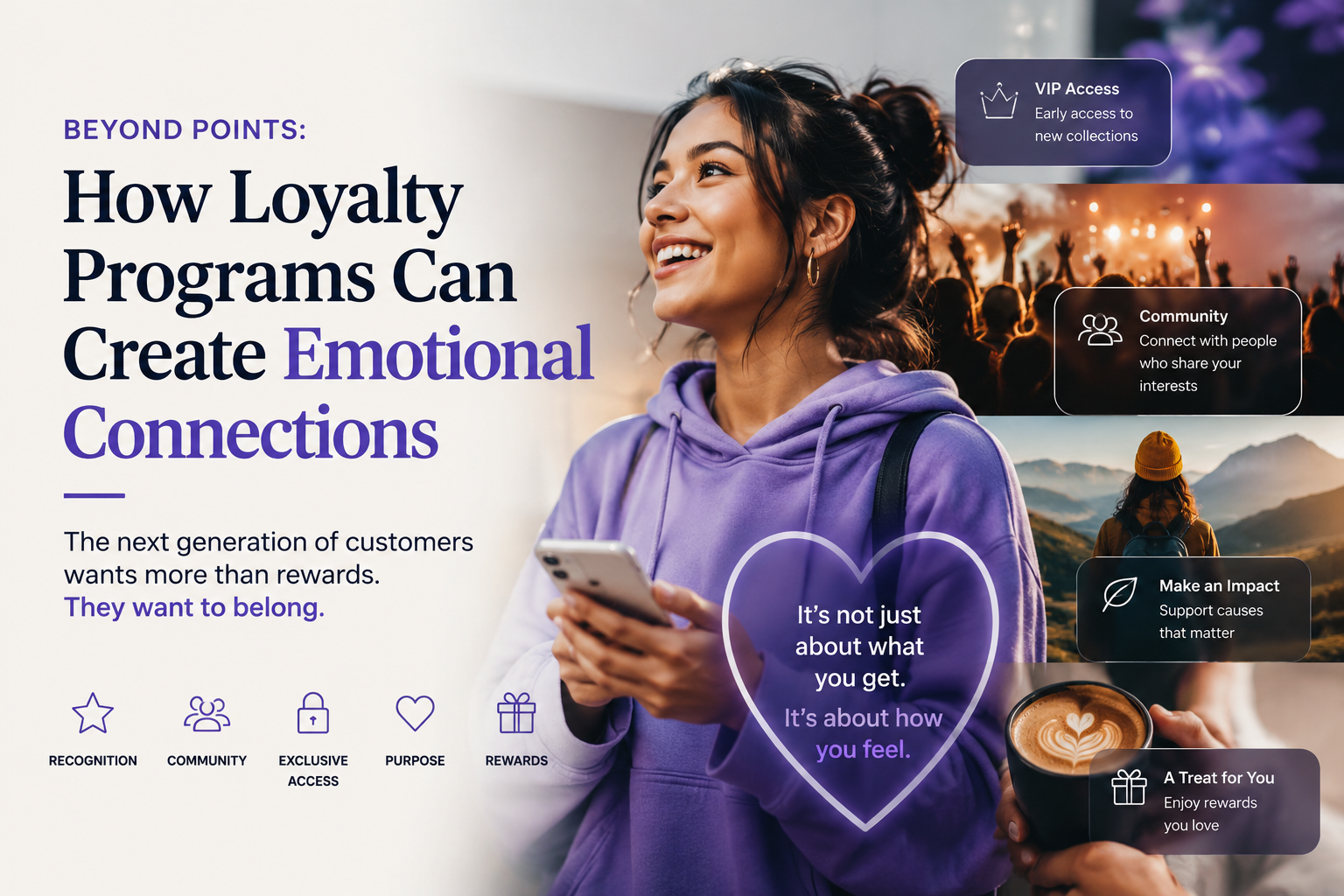
Discover why the most successful loyalty programs combine economic rewards with emotional engagement—and how brands can create belonging, recognition, and shared experiences that drive lasting loyalty.
Executive Summary
While the average U.S. consumer belongs to 16.6 loyalty programs, they actively engage with fewer than half—revealing a critical gap between membership and genuine loyalty. Brands that layer emotional engagement onto economic rewards achieve 52% higher customer lifetime value and 2.3x greater retention, signaling the next evolution in loyalty program design.
Here's a question worth considering: When was the last time you felt genuinely excited about earning points? Now compare that to how you felt getting early access to a product you'd been anticipating, or being recognized as a VIP at your favorite store, or participating in a brand community built around something you care about. The difference between these experiences reveals everything about where loyalty programs are headed.
For decades, loyalty has been synonymous with transactions. Customers spend money, earn points, redeem rewards, and return to repeat the cycle. This formula has delivered measurable value and remains foundational to retention strategies. But consumer expectations—particularly among younger generations—are evolving faster than many programs have adapted.
The data tells a compelling story. Research from Bond Brand Loyalty's 2024 report found that while consumers belong to an average of 16.6 loyalty programs, they actively engage with only 6.7 of them.[1] This engagement gap isn't about program awareness—it's about emotional relevance. When programs feel interchangeable, customers treat them that way.
The Generational Shift: When Values Matter More Than Discounts
Gen Z consumers have fundamentally different loyalty drivers than previous generations. They've grown up in a world shaped by social communities, creator ecosystems, gaming platforms, and digital memberships. They're accustomed to brands that understand their interests, reflect their values, and make them feel like participants rather than simply customers.
The numbers back this up. A January 2025 study by the National Retail Federation found that 73% of Gen Z consumers say they're more loyal to brands that align with their personal values, compared to 55% of Baby Boomers.[2] Even more telling: 68% of Gen Z loyalty program members prefer non-monetary rewards like exclusive experiences or early product access over traditional points, according to December 2024 research from Forrester examining 2,400 U.S. consumers aged 18-27.[3]
This isn't about rejecting economic value—Gen Z consumers still appreciate rewards and savings. But they're signaling that economic incentives alone don't create the kind of loyalty that drives long-term advocacy and emotional connection. They want to feel like insiders, not just shoppers.
The Gaming Parallel
Consider why millions of people spend hours in gaming ecosystems like Fortnite or Roblox without direct monetary rewards. They return for achievement recognition, social connection, exclusive access, and visible status progression. These same psychological drivers can transform loyalty programs from transactional exchanges into emotional relationships.
What Emotional Loyalty Actually Looks Like
Emotional loyalty manifests in experiences that create lasting memories and deeper brand relationships. Think about how Sephora's Beauty Insider program creates aspirational status through its three-tier structure. Rouge members—the top tier—don't just earn more points; they gain access to exclusive product launches, private shopping events, and personalized beauty consultations. A January 2025 analysis by Chain Store Age found that Rouge members visit stores 8.4 times annually compared to 3.2 visits for non-members.[4] The difference isn't just discount depth—it's the feeling of recognition and belonging.
Target Circle demonstrates how community and purpose drive engagement. The program allows its 170+ million members to vote on charitable donations each quarter, directing Target's contributions to local nonprofits. A November 2024 Harvard Business Review case study found that members who participated in community voting showed 23% higher annual spending compared to members who only engaged with traditional rewards.[5] When customers feel they're part of something larger than a transaction, their connection to the brand deepens.
Starbucks Rewards has mastered gamification and personalization at scale. With 34.3 million active U.S. members in Q4 2024, the program uses activity-based challenges like "Star Dash" to create game-like urgency and achievement recognition. According to Starbucks' Q1 2025 earnings call, Rewards members account for 57% of U.S. company-operated store sales, with members visiting 3x more frequently than non-members.[6] The mobile app's AI-powered personalized recommendations make members feel understood rather than marketed to.
Emotional Loyalty Drivers in Action
- Belonging: Creating communities around shared interests or values where members connect with each other, not just the brand
- Recognition: Personalized acknowledgment of milestones, achievements, and member status that makes customers feel seen
- Access: Exclusive experiences, early product launches, or VIP services that create insider status
- Purpose: Connecting purchases to causes or community impact that aligns with customer values
- Achievement: Gamified challenges, visible progress tracking, and milestone celebrations that create engagement loops
- Personal Relevance: AI-powered personalization that demonstrates deep understanding of individual preferences
Activity-Based Engagement: Rewarding Participation, Not Just Purchases
One of the most powerful shifts in loyalty program design is the move toward activity-based promotions—rewarding customer behaviors beyond transactions. Dick's Sporting Goods evolved its ScoreCard program to reward members for logging workouts, completing fitness challenges, and engaging with content. A December 2024 Retail Dive analysis noted that this activity-based model increased member engagement frequency by 41% in the first year, with members checking the app 2.3x more often than with the previous transaction-only program.[7]
The business case for activity-based promotions is compelling. A Q1 2025 McKinsey study of 500 North American retailers found that activity-based promotions—challenges, milestones, engagement tasks—generate 34% higher incremental purchase frequency compared to equivalent-value discount promotions.[8] This validates a fundamental insight: customers respond more strongly when they're invited to participate rather than simply receive passive rewards.
Activity-based engagement creates habit formation through small, frequent interaction loops. When customers check your app to track challenge progress, browse exclusive content, or participate in community features, they're building behavioral patterns that extend far beyond purchase moments. These micro-engagements keep your brand top-of-mind and create multiple touchpoints for relationship-building.
The Exchange Solutions Advantage
ES Loyalty and ES Promo Enhance enable activity-based promotions without custom development. Reward customers for app check-ins, content consumption, community participation, social sharing, and milestone achievements—not just purchases. The gamification features create visible progress tracking and achievement recognition that drive engagement loops. With ES Loyalty's flexible rule engine, you can configure sophisticated activity-based challenges in hours, not months, and ES Loyalty Boost's AI-powered personalization ensures each member receives relevant challenges matched to their interests and behaviors.
The Both/And Strategy: Economic Value Meets Emotional Connection
The most effective approach isn't choosing between transactional and emotional loyalty—it's integrating both. Points, discounts, and rewards remain valuable, but they should serve as part of a broader relationship rather than the entire relationship itself. Research from Deloitte Digital published in November 2024 shows that brands with active community features in their loyalty programs see 2.3x higher engagement rates and 41% longer member retention compared to transaction-only programs.[9]
A November 2024 study by PwC examining loyalty innovation across 800 global brands found that programs incorporating non-monetary rewards—badges, exclusive content, VIP access, personalized recognition—achieve 39% higher Net Promoter Scores than purely transactional programs.[10] These intangible rewards create emotional memories that outlast the value of any individual discount. Customers may forget the 10% off they received last month, but they remember the early access to a limited-edition product, the personalized thank-you message on their membership anniversary, or the community event where they met like-minded enthusiasts.
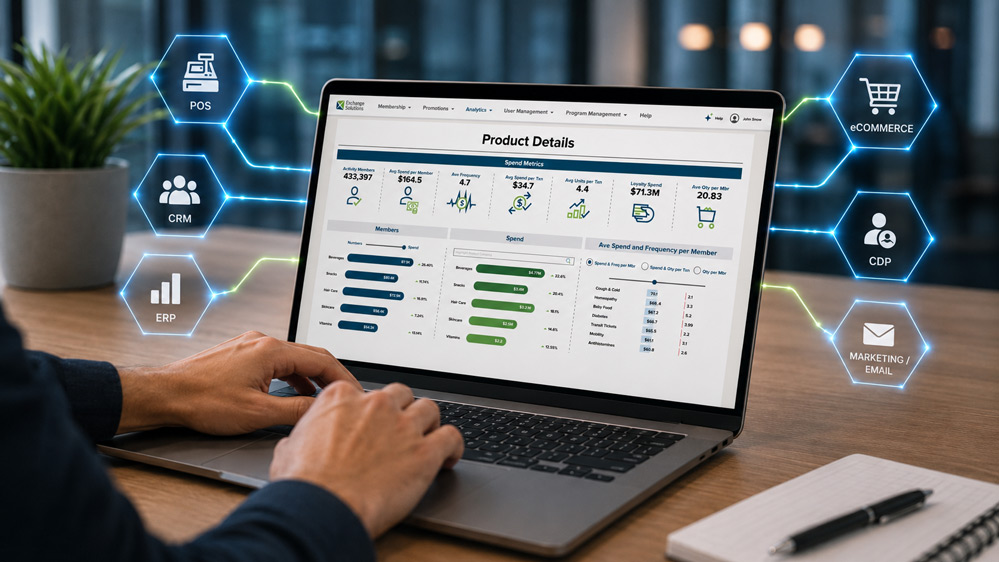
The platform capabilities required for this both/and approach have evolved significantly. Modern loyalty technologies like ES Loyalty provide unified member databases across all touchpoints—POS, e-commerce, mobile app, email, in-store—ensuring customers feel recognized regardless of how they interact with your brand. ES Engage delivers real-time personalization for online visitors, analyzing session-level behavior to present contextually relevant offers that feel helpful rather than promotional. And ES Promo Enhance layers advanced targeting and activity-based promotions onto existing systems without requiring complete platform replacement—enabling rapid deployment in as little as 90 days.
The AI foundation underlying these platforms makes personalization at scale achievable for mid-market retailers, not just enterprise giants. Exchange Solutions' Audience Recommender allows marketers to create sophisticated segments using natural language prompts like "identify high-value shoppers who haven't purchased in 3 months"—democratizing data access without requiring SQL expertise or dedicated data science teams. The Member Scoring & Insights capability continuously scores members using proven RFM and CLV models combined with machine learning, providing explainable recommendations that marketers can trust and act on immediately.
Measuring What Matters: Beyond Transactions to True Engagement
If emotional loyalty is the goal, measurement frameworks must evolve beyond traditional metrics. Redemption rates and point liability remain important, but they tell an incomplete story. A January 2025 Forrester benchmark study found that retailers tracking engagement breadth—the number of different program features used—alongside transaction metrics achieve 28% better member retention compared to retailers tracking transactions alone.[11]
Consider expanding your measurement framework to include engagement frequency (app opens, content views, community participation), member sentiment and Net Promoter Score among active versus inactive participants, social sharing and referral behavior, and program advocacy through unprompted mentions. A December 2024 Boston Consulting Group analysis of 200 retail loyalty programs found that programs with unified member profiles across all channels achieve 47% higher customer lifetime value compared to channel-siloed programs.[12]
The ultimate metric might be memory persistence: do customers recall specific experiences, recognition moments, and feelings of belonging long after they've forgotten the rewards they earned? A November 2024 Bain & Company study found that retailers with top-quartile loyalty program NPS scores (65+) achieve 2.8x higher organic growth rates compared to retailers with bottom-quartile scores (below 35).[13] Emotional loyalty drives advocacy; advocacy drives growth.
The Path Forward: Loyalty as Relationship, Not Transaction
The loyalty programs that will thrive in the coming years won't abandon economic incentives—they'll transcend them. They'll create communities where customers feel they belong. They'll recognize individual achievements and milestones in personalized ways. They'll provide exclusive access that makes members feel like insiders. They'll connect purchases to purposes that align with customer values. And they'll do all of this while still delivering the points, discounts, and rewards that customers appreciate.
This evolution doesn't require starting from scratch. Modern modular platforms enable you to layer emotional engagement capabilities onto existing programs, adding gamification, activity-based challenges, community features, and AI-powered personalization without disrupting functioning systems. The technology exists. The business case is proven. The question isn't whether to evolve—it's how quickly you can begin.
So here's the challenge for every loyalty marketer: If your customers remember the experiences, recognition, and sense of belonging your brand creates long after they've forgotten the rewards they earned, what does that tell you about the true nature of loyalty? And more importantly, what are you going to do about it?