

Discover how B2B software leaders are integrating customer success metrics and behavioral analytics to create predictive loyalty strategies that dramatically reduce churn.
Executive Summary
As SaaS companies face increasing churn pressure, traditional loyalty programs have proven insufficient for B2B retention. Leading software companies integrating customer success metrics with behavioral analytics can predict potential churn 60-90 days before traditional warning signs appear, achieving 120%+ Net Revenue Retention rates compared to industry averages.
The CTO of a mid-market SaaS company stared at her quarterly retention report with growing concern. Despite launching a partner points program six months earlier, their churn rate remained stubbornly high at 18%. "We're doing everything by the book," she told her customer success team. "Onboarding calls, quarterly business reviews, a points-based loyalty program—and we're still losing nearly one in five customers annually." What she didn't realize was that she was fighting today's retention battle with yesterday's weapons. The loyalty landscape for B2B software companies has fundamentally transformed, and the playbook that worked five years ago no longer delivers results.
The Evolution Beyond Traditional B2B Loyalty
Traditional B2B loyalty programs have historically focused on transactional benefits—volume discounts, early access to features, and anniversary rewards. These approaches made sense in a world where software purchases followed predictable adoption cycles and switching costs were prohibitively high. But today's SaaS ecosystem has disrupted these fundamentals. Contracts have shortened, implementation has simplified, and alternatives are perpetually emerging. The result? Your customers are continuously evaluating their relationship with your solution, not just at renewal time.
According to recent research from Custify, 67% of SaaS companies now report that customers make renewal decisions based on ongoing value perception rather than contractual lock-in.[1] This shift means that loyalty must be earned continuously through demonstrated value, not purchased through traditional incentive programs. As one customer success leader at a leading project management platform noted, "We realized our points program was irrelevant if users weren't experiencing success within the product itself."
The most innovative software companies have recognized this fundamental change and responded by reimagining loyalty as an integration of customer success metrics, product usage patterns, and strategic engagement incentives. Rather than treating loyalty as a separate initiative managed by marketing, they're building comprehensive ecosystems where every customer interaction contributes to both immediate value delivery and long-term retention.
The Loyalty Integration Gap
While 86% of B2B SaaS companies collect customer success metrics and 79% operate some form of loyalty program, only 23% have systematically integrated these two domains into a cohesive strategy. This integration gap represents a significant opportunity for competitive differentiation.
Customer Success Metrics as Loyalty Predictors
The most sophisticated B2B software companies have discovered that customer success metrics aren't just operational indicators—they're powerful predictive signals of future loyalty. While traditional loyalty programs might track redemption rates and enrollment numbers, forward-thinking SaaS providers are building "digital fingerprints" of successful customers by analyzing patterns across multiple engagement dimensions.
Leading organizations have moved beyond simplistic usage metrics like login frequency to develop nuanced engagement scores that weight different interactions based on their correlation with long-term retention. For instance, one enterprise software provider discovered that customers who utilized their API integration capabilities within the first 60 days were 3.7x more likely to renew and 2.2x more likely to expand their contract value.[2] This insight transformed their onboarding sequence to prioritize API integration support, resulting in a 14% improvement in first-year retention.
Similarly, ChurnZero reports that leading SaaS companies are moving from account-level to user-level engagement tracking, recognizing that an account with one power user and 19 inactive seats has very different loyalty dynamics than one with moderate engagement across all 20 users.[3] This granularity allows for more precise intervention strategies and more effective loyalty initiatives targeted at specific user personas within customer organizations.
Key Customer Success Metrics That Predict Loyalty
- Feature Adoption Breadth: Percentage of available features regularly used (Target: 70%+)
- Time-to-Value: Days between implementation and first value milestone
- User Activation Rate: Percentage of licensed seats that become regular users
- Support Resolution Satisfaction: CSAT scores for issue resolution
- Community Engagement: Participation in forums, events, and knowledge sharing
- Workflow Integration Depth: How deeply embedded your solution is in daily workflows
The Exchange Solutions Advantage
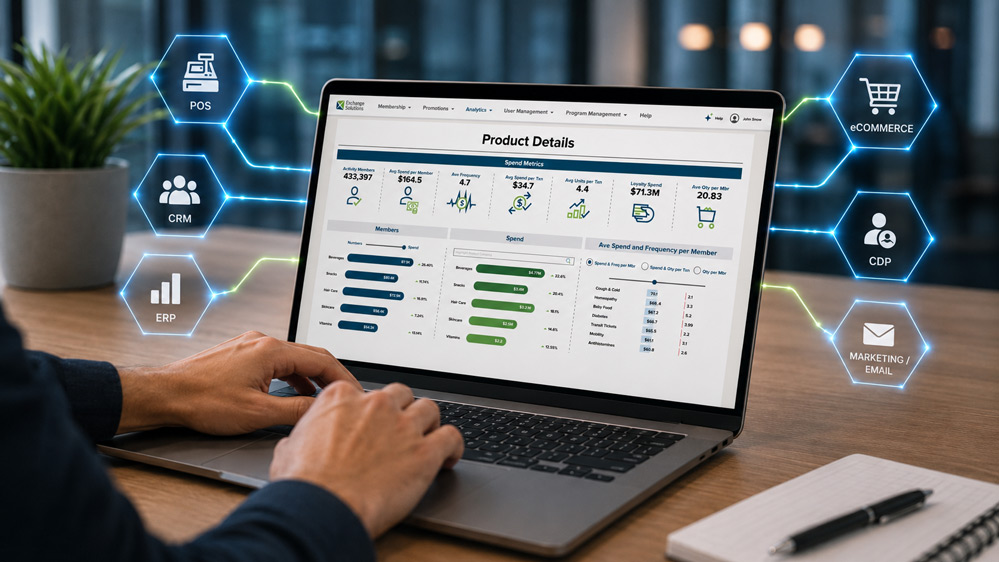
Exchange Solutions' engagement scoring platform transforms disconnected customer success data into actionable loyalty insights through proprietary behavioral analytics. Our AI-powered technology identifies the specific engagement patterns most predictive of retention for your unique customer base, allowing you to design loyalty initiatives that target the exact behaviors that drive long-term value. Unlike one-size-fits-all approaches, our modular architecture integrates with your existing tech stack to deliver a unified view of customer health, engagement trends, and loyalty potential.
Product Usage Data as an Early Warning System
The most sophisticated B2B SaaS companies have transformed product usage data from a passive monitoring tool into a proactive early warning system for potential churn. By leveraging AI-powered behavioral analytics, these organizations can identify patterns that precede customer churn 60-90 days before traditional warning signs appear.[4] This predictive capability fundamentally changes the loyalty equation from reactive retention to proactive engagement.
Consider how Adobe transformed its Creative Cloud retention strategy by analyzing billions of user interactions to identify the "moments that matter" in customer journeys. Rather than waiting for declining usage or support tickets, they identified specific patterns—like a designer abandoning complex projects after repeated tool crashes—that predicted potential defection months in advance. By deploying targeted interventions at these critical moments (in this case, personalized tutorial content addressing specific technical challenges), they improved retention rates by 18% among at-risk segments.
Significantly, product usage data doesn't just reveal problems—it uncovers opportunities. Leading SaaS providers are using behavioral analytics to identify patterns associated with expansion potential. For example, Moxo reports that when multiple users within a customer organization export data to the same third-party tools, it often signals an integration need that represents both a churn risk and an upsell opportunity.[5] By proactively addressing these signals with tailored loyalty incentives—such as integration deployment credits or specialized training—forward-thinking vendors convert potential churn points into expansion opportunities.
Certification Programs: The Dual-Purpose Loyalty Tool
Among the most innovative loyalty strategies employed by B2B SaaS leaders, certification programs have emerged as powerful dual-purpose tools that simultaneously upskill users and create lasting loyalty. Unlike traditional points programs, certification initiatives create value on both sides of the equation: customers gain professional development and career advancement opportunities, while vendors develop more proficient users who drive deeper product adoption.
Salesforce pioneered this approach with its Trailhead certification ecosystem, but today's most innovative programs go beyond technical education to address broader business outcomes. For instance, HubSpot's certification program includes not just platform proficiency but marketing strategy, sales methodology, and customer experience frameworks. This approach creates users who aren't just technically capable but strategically invested in the platform's approach to business problems. The result? Certified users demonstrate 34% higher product adoption, 27% lower support costs, and 41% higher likelihood of advocating for platform expansion.[6]
The most effective certification programs follow a progressive journey that aligns with the customer lifecycle. Entry-level certifications focus on immediate value realization, mid-level programs emphasize optimization and efficiency, and advanced certifications develop strategic capabilities that align platform capabilities with business outcomes. Each level strategically addresses different churn risks while simultaneously creating professional incentives for continued engagement.
Journey-Mapped Incentives: The Framework for Modern B2B Loyalty
The fundamental shift in B2B loyalty strategy involves moving away from one-size-fits-all incentive programs toward journey-mapped incentives that address specific customer needs at precise moments. This approach recognizes that different customers need different motivations at different points in their relationship with your platform. Implementation partners need different incentives than day-to-day administrators, who in turn need different motivations than executive sponsors.
Leading B2B software companies are developing sophisticated frameworks that map specific customer journey touchpoints to appropriate loyalty mechanisms. During onboarding, incentives focus on activation and initial value realization—perhaps offering implementation credits or migration support. As customers move into the adoption phase, incentives shift toward feature exploration and best practice development through targeted training rewards. Mature customers receive incentives focused on optimization, integration, and strategic alignment, while renewal phase incentives emphasize quantified ROI and business outcome validation.
Importantly, this journey-mapped approach requires a fundamental rethinking of how loyalty incentives are structured. Rather than universal points systems, successful programs employ a diverse toolkit of mechanisms tailored to specific journey points. Early journey points might leverage gamification elements that create momentum through quick wins and visible progress. Mid-journey incentives often focus on knowledge-building and community connection, while late-journey incentives typically emphasize exclusivity, co-innovation, and strategic partnership opportunities.
Journey-Mapped Loyalty Framework
- Onboarding Phase: Implementation credits, migration support, quick-win certifications
- Adoption Phase: Feature exploration rewards, role-based training, use case templates
- Maturity Phase: Integration incentives, optimization services, strategic advisory access
- Expansion/Renewal Phase: Outcome documentation tools, executive briefings, co-innovation opportunities
The Exchange Solutions Advantage
Exchange Solutions' Journey-Mapped Incentive Engine allows B2B SaaS companies to deploy precisely targeted loyalty mechanisms at each customer journey stage. Our platform analyzes behavioral patterns to recommend the optimal incentive type, timing, and delivery mechanism for each customer segment. With our modular approach, you can rapidly test different incentive strategies, measure their impact on specific retention indicators, and continuously optimize your loyalty approach based on real-time feedback. Clients implementing our journey-mapped approach have seen retention improvements of 12-24% and expansion revenue increases of 18-35% within the first year.
Building Your Integrated B2B Loyalty Strategy
Creating an integrated B2B loyalty strategy requires breaking down traditional silos between customer success teams, product management, marketing, and sales. The most successful implementations start with a unified customer data foundation that combines product usage metrics, support interactions, community engagement, and business outcomes into a comprehensive view of customer health. This integrated data layer becomes the foundation for identifying the specific engagement patterns most strongly correlated with retention and expansion for your unique customer base.
With this foundation in place, the next step involves mapping your customer journey with precision. This goes beyond generic journey phases to identify the specific moments that matter most for your solution. For a data analytics platform, the moment a customer successfully builds their first custom dashboard might represent a critical milestone. For a CRM, it might be importing their customer database and completing their first automated workflow. These precise moments become the anchoring points for your journey-mapped incentive strategy.
Implementation requires cross-functional alignment around customer lifetime value as the north star metric. When loyalty is viewed through this lens, investments in certification programs, personalized success planning, and targeted incentives become strategic initiatives tied directly to revenue outcomes rather than cost centers. This perspective shift is critical for securing the executive support and resources needed for program success.
Success Metrics Evolution
Leading B2B SaaS companies are supplementing traditional loyalty metrics (NPS, renewal rates) with more predictive indicators like feature adoption velocity, success milestone achievement rates, and engagement consistency scores. These leading indicators provide earlier insight into loyalty trends, allowing for more proactive intervention strategies.
The New Loyalty Imperative
As B2B SaaS companies face increasing competitive pressure and economic uncertainty, the need for sophisticated, data-driven loyalty strategies has never been greater. Traditional approaches focused on points, tiers, and generic rewards are no longer sufficient in an environment where customers continuously evaluate the value your solution delivers. The path forward requires integrating customer success metrics with behavioral analytics to create predictive loyalty strategies that address specific needs at precise moments.
The organizations that will thrive in this new landscape are those that view loyalty not as a marketing program but as a comprehensive business strategy spanning product development, customer success, education, and community. By building data-driven frameworks that map customer journey touchpoints to appropriate loyalty mechanisms, you can transform reactive retention efforts into proactive engagement strategies that not only prevent churn but accelerate expansion opportunities.
The future of B2B loyalty isn't about points—it's about creating such compelling customer experiences, substantiated by concrete value metrics, that your software becomes an indispensable element of your customers' success. When you achieve this level of integration, loyalty transforms from a program you run to an outcome you achieve.