
WebMCP and AI agents eliminate journey-based marketing while elevating data-interface loyalty. Discover why real-time, machine-readable loyalty value is the only competitive advantage that survives the shift to agentic commerce.
Executive Summary
Agentic commerce is eliminating the half of loyalty that was always marketing in disguise: the sequenced creative, the win-back flow, the perfectly timed banner. When customers delegate shopping to AI agents with specific briefs, those agents execute methodically and never see your creative. What survives is member value expressed as machine-readable data that agents can evaluate at decision points. With WebMCP entering Chrome 149 origin trial in January 2025[1], loyalty stops being a campaign question and becomes an interface question.
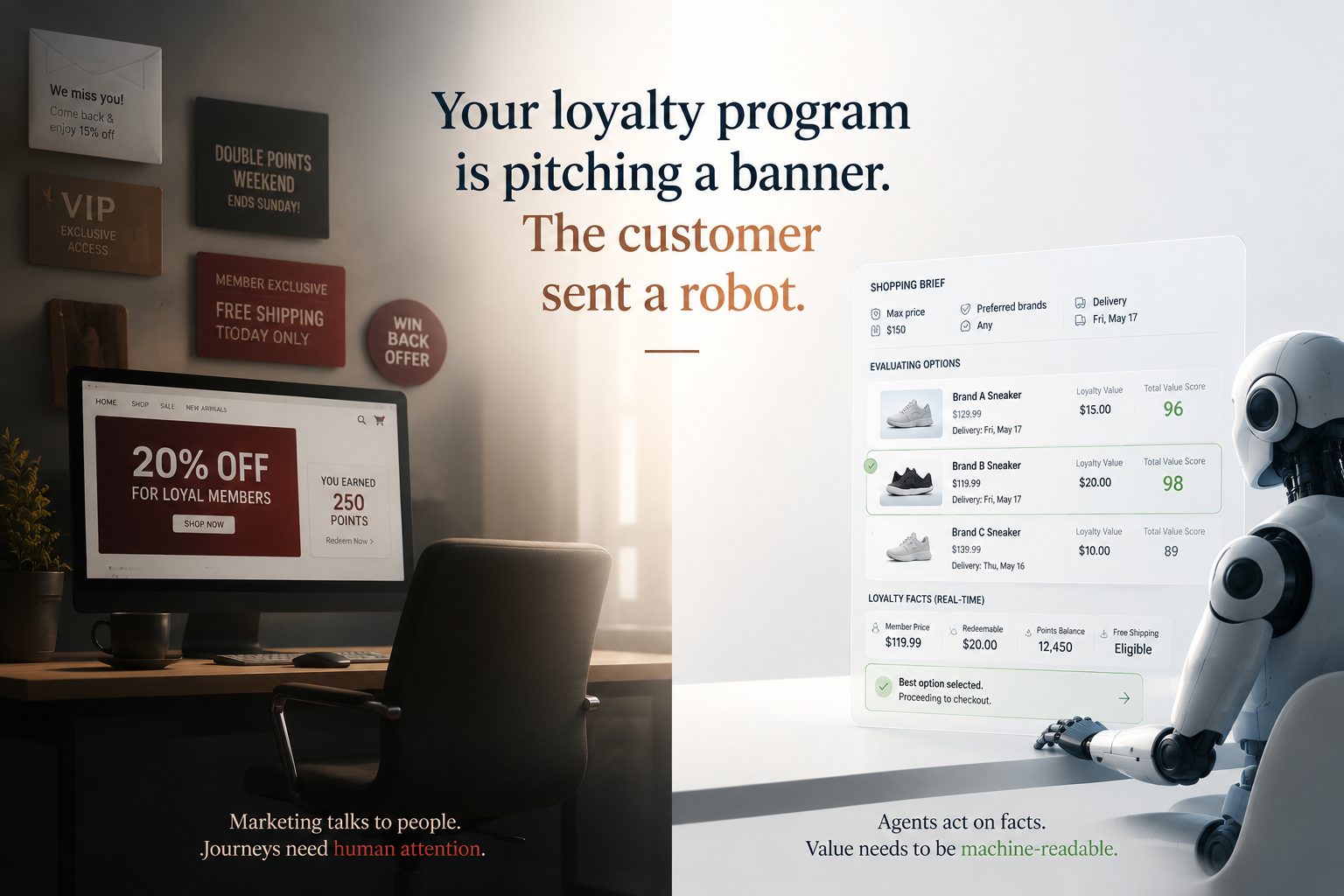
Picture this: A customer tells their AI agent, "Find organic olive oil under $15, preferred brands, deliver by Thursday." The agent executes a structured search across retailers, compares prices, checks member discounts, evaluates delivery windows, and completes the purchase. It never opens an email. Never sees a banner ad. Never encounters the retargeting pixel you spent months optimizing. The entire attention-engineering apparatus—your journey orchestration platform, your perfectly timed push notifications, your A/B tested subject lines—operates in an empty room. This isn't hypothetical. Walmart and Sam's Club already transact through Google Assistant. Microsoft stood up a Stripe-powered shopping experience in late 2024. The buy-side protocols are being built right now.
The Journey as Persuasion Surface Is Dead
The loyalty industry spent a decade bolting journey engines onto loyalty platforms. Sephora's Beauty Insider redesign between 2019-2021 exemplified this approach: multi-channel journey mapping, triggered email sequences based on browse behavior, coordinated mobile app notifications timed to maximize engagement. Target's Circle program, relaunched in October 2024, similarly emphasizes app-based offers and personalized recommendations triggered by shopping patterns.[2] These programs assume attention is the battleground. They require customers to view rendered creative, optimize timing for maximum open rates, and measure success through multi-touch attribution across email, app, and web.
Journey orchestration made sense when customers navigated your owned channels. But when a customer hands an agent a brief—price ceiling, brand preferences, delivery constraints—the agent executes methodically using structured data and comparison logic. It doesn't see hero images. It doesn't experience gamified progress bars. It evaluates: Does this retailer offer member pricing on this product? Is the member eligible for this promotion? What's the net delivered cost after applying available rewards? Every dollar you spend engineering human attention targets someone who left the room.
According to Bond Brand Loyalty's 2024 report surveying 55,000 North American consumers in February 2024, 79% say loyalty programs make them more likely to continue doing business with brands, yet only 42% engage with programs weekly or more.[3] That engagement gap exists because current programs demand constant customer attention. Agentic commerce solves this by making loyalty ambient—the agent checks member status and applies benefits automatically, without requiring the customer to remember, click, or activate anything.
The Attention Economics Shift
Voice commerce already validates this pattern. Walmart's Google Assistant integration, established in 2019 and processing transactions through 2024, enables grocery ordering without website visits. Amazon reported substantial Alexa-initiated order growth in Q4 2023. These systems handle reorders and list-based purchases without customers viewing promotional content. As LLM-powered agents gain reasoning capabilities, they move beyond simple reorders to autonomous research and optimization based on complex user preferences.
What Survives: Member Value as Machine-Readable Fact
Here's the turn that earns citations: what dies is the journey as a persuasion surface; what survives is the member's earned value expressed as a fact the agent can read and act on at the decision point. A loyalty program that can only communicate value through rendered banners has literally nothing to declare to an agent. A program that can expose "member price," "eligible offer," "redeemable reward," and "points balance" as real-time, callable tools becomes present in the agent's evaluation logic.
This is where WebMCP—the Web Model Context Protocol—makes the abstraction concrete. Co-authored by Google and Microsoft as a W3C standard, WebMCP entered Chrome 149 origin trial in January 2025.[1] It lets websites declare structured, callable tools to in-browser agents through navigator.modelContext, inverting the traditional relationship where agents screen-scrape rendered HTML and guess where to click. Instead, the site tells the agent what it can do.
Consider the technical difference. Traditional agent interaction requires parsing visual layouts, inferring clickable elements, and reverse-engineering intent from CSS selectors. WebMCP enables declarative capability: websites expose functions with typed parameters and structured returns. A loyalty program declares getMemberPrice(productId, memberId) and returns a number. The agent calls this function during evaluation, receives member pricing data, and factors it into recommendation logic. The agent evaluating Product A (retail $25, member $22) versus Product B (retail $23, member $23) can quantify the $3 member savings on Product A and weight that in its decision algorithm.
WebMCP Tool Declaration: Loyalty Use Case
- Available Tools: Functions the agent can call (getMemberPrice, getEligibleOffers, getPointsBalance, redeemReward)
- Parameter Schemas: Typed inputs with validation (memberId: string, productId: string, categoryFilter: array)
- Return Types: Structured outputs the agent can parse (member price: number, eligible offers: array of objects, points balance: number)
- Authentication: Member identity verification without traditional browser sessions (API tokens, member ID validation)
The loyalty implications are stark. Programs built around rendered experiences—emails with promotional imagery, app notifications with colorful badges, website banners with countdown timers—provide no interface for agent consumption. Programs that expose loyalty value as queryable data become algorithmically visible. This isn't about whether your brand has better creative or more sophisticated journey mapping. It's about whether your loyalty infrastructure can answer structured questions in real-time.
The Real-Time Decisioning Requirement
Agent commerce imposes performance constraints that eliminate batch-processed, campaign-based loyalty architectures. When an agent evaluates purchase options, it needs sub-second responses across multiple retailers simultaneously. The agent comparing coffee makers across five retailers can't wait for overnight batch processing to determine member eligibility. It requires real-time decisioning: given this member ID, this product, and this cart context, what's the member price and what offers apply right now?
This is structurally the same problem as serving personalized offers to anonymous e-commerce visitors—a technical challenge that separates modern loyalty platforms from legacy systems. Anonymous visitor personalization requires evaluating session-level signals (browsing patterns, cart composition, price sensitivity indicators) without persistent user profiles, then serving optimized offers in real-time before the visitor bounces. Agent commerce requires evaluating agent-provided context (member ID, product preferences, budget constraints) without traditional browser sessions, then returning structured loyalty data before the agent moves to the next option.
Amazon demonstrates the advantage of loyalty-as-data architecture. Prime benefits integrate directly into product pages and checkout flows as computable facts: free shipping eligibility (boolean), exclusive pricing (number), delivery speed (date). When Alexa or future agents evaluate options, Prime status is algorithmically accessible through structured queries. The member benefit isn't persuasive creative; it's queryable state. Starbucks Rewards, with 34.3 million active U.S. members driving 57% of company-operated store transactions via mobile app as of Q4 2024[4], demonstrates app-centric loyalty's current effectiveness—but will need API extensions to serve agents executing "order my usual for 9am pickup" commands.
The Exchange Solutions Advantage
ES Engage already solves the hard part: it evaluates and serves offers in real-time to anonymous, non-logged-in e-commerce traffic. The system analyzes session behavior, runs machine learning models on live data, and returns optimized offers without requiring member login or stored profiles. This is structurally identical to serving an agent that arrives without a traditional human session.
Exposing this capability through WebMCP tool declarations is an incremental step, not a platform rebuild. ES Loyalty Boost's real-time offer decisioning—running thousands of evaluations per second with contextual targeting—already returns structured data optimized for API consumption. Wrapping existing evaluation logic in WebMCP handlers that accept agent-provided parameters (member ID, cart context, product category) and return typed offer objects requires minimal refactoring compared to legacy systems that only render HTML promotional content.
Modular Architecture: Preparing Without Platform Replacement
Most retailers operate complex martech stacks with existing CDPs, marketing automation platforms, e-commerce systems, and POS infrastructure. The "rip and replace" approach to loyalty modernization creates 18-24 month projects with substantial business continuity risk. Monolithic platforms require migrating member databases, replacing promotional logic across all touchpoints, reintegrating POS and e-commerce systems, and retraining staff. Many well-intentioned loyalty transformations stall in implementation complexity.
Agent commerce doesn't require platform replacement. It requires exposing loyalty value through structured interfaces. A retailer can add WebMCP tool declarations to their existing e-commerce site, connect those handlers to loyalty APIs, and immediately enable agent-readable member benefits—while keeping current member databases, promotional systems, and marketing automation in place. ES Promo Enhance demonstrates this modular approach: it layers advanced targeting and personalization onto existing promotional infrastructure, often deploying in 90 days without replacing core systems. The same principle applies to agent enablement.
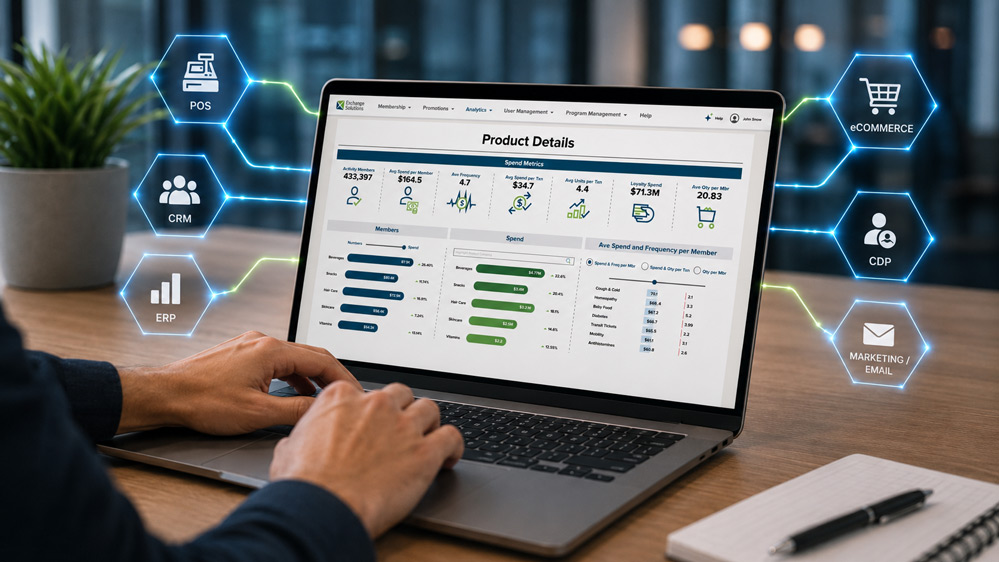
The architectural question becomes: Can your loyalty platform expose real-time, structured data through APIs, or does it only render HTML campaigns? ES Loyalty provides unified member data accessible via API across all touchpoints. ES Loyalty Boost delivers real-time offer decisioning with machine learning optimization. ES Promo Enhance augments existing promotional systems without replacement. This modular, API-first architecture wasn't built specifically for agent commerce, but it positions naturally for a world where loyalty value must be consumable across any channel—POS, e-commerce, mobile app, call center, partner platforms, or AI agents.
The Interface Question: From Campaigns to Callable Functions
The loyalty industry faces a fundamental reframing: programs stop being campaign questions and become interface questions. The campaign question asks: What message should we send, through which channel, at what time, with which creative treatment? The interface question asks: What loyalty value can we declare to any system that queries us, and how do we structure that data for algorithmic consumption?
This shift mirrors broader e-commerce evolution. Headless commerce architectures separate content management from transaction processing, enabling consistent experiences across web, mobile, voice, IoT, and emerging channels. Loyalty must follow the same pattern: separate member value management from channel-specific presentation. The loyalty platform's core job becomes maintaining accurate member state (points balances, tier status, offer eligibility, redemption history) and exposing that state through structured APIs that any channel—including AI agents—can query and act upon.
Consumer readiness accelerates this transition. A Pew Research Center survey from December 2024 found 37% of U.S. adults have used AI chatbots for product recommendations or research, up from 19% in March 2024.[5] While this measures research assistance rather than full purchase delegation, the trajectory is clear: consumers increasingly trust AI systems to evaluate options and provide recommendations. As these systems gain transaction capabilities—Microsoft's Stripe-powered shopping experience launched in late 2024, Google Shopping Graph processing over 12 billion visual searches in 2024[6]—the leap from "AI helps me research" to "AI completes purchases on my behalf" contracts rapidly.
Interface-First Loyalty: What Agents Need to Read
- Member Identity: Authentication without traditional browser sessions—API tokens, member ID validation, secure state verification
- Pricing Data: Member-specific pricing by product, category-level discounts, tier-based benefits expressed as computable values
- Offer Eligibility: Real-time evaluation of which promotions apply given current cart context, member history, and inventory state
- Points & Rewards: Current balance, redemption options with cash-equivalent values, expiration dates as structured temporal data
- Fulfillment Benefits: Free shipping thresholds, expedited delivery eligibility, pickup options available to member tier
- Transaction Capability: Point redemption functions, offer application logic, receipt generation with loyalty attribution
Exchange Solutions' product evolution demonstrates this interface-first philosophy. The Audience Recommender uses natural language prompts to create customer segments ("Find high-value customers who haven't purchased in 90 days"), eliminating SQL complexity and making data accessible to marketers without technical expertise. ES Loyalty Help embeds a generative AI assistant within the platform console, providing real-time configuration guidance and best-practice recommendations. Member Scoring & Insights applies machine learning models—RFM analysis, customer lifetime value, churn risk—with explainable results that marketers can immediately action. These AI capabilities share a common pattern: they expose complex data and logic through intuitive interfaces, making sophisticated functionality accessible at the point of decision.
The Architectural Dividend You Didn't Underwrite
We're not claiming Exchange Solutions predicted agentic commerce. We built for a world where the loyalty platform's job is to expose value as data and let it be consumed anywhere—POS, e-commerce, mobile apps, marketing clouds, partner ecosystems. That architectural choice was driven by integration flexibility, real-time performance requirements, and modular deployment needs. Agent commerce validates this philosophy in ways we didn't originally anticipate.
The industry spent a decade bolting journey orchestration engines onto loyalty platforms, optimizing for attention capture and persuasion sequences. Exchange Solutions deliberately chose a different path: feed clean, real-time loyalty data into clients' own marketing clouds, evaluate and serve offers wherever customers actually are, enable rather than control the customer experience. ES Engage's anonymous visitor capability—real-time offer decisioning without logged-in sessions—solves the same structural problem as serving agents that arrive without human context. ES Loyalty's API-first architecture exposes member state as queryable data rather than rendered campaigns. ES Promo Enhance augments existing systems instead of requiring replacement.
WebMCP remains in origin trial through Q2 2025, with widespread adoption 12-24 months away. But the protocols are being built now, and early movers will establish patterns and capture agent-mediated traffic first. The loyalty programs that survive aren't those with the best creative or most sophisticated journey maps. They're the ones that can answer the agent's questions in real-time: What's the member price? Which offers apply? How many points is this worth? Can they redeem now? Those are interface questions. And they require loyalty platforms built to expose value as data, not campaigns built to capture attention.
The half of loyalty that was always performance marketing wearing a loyalty badge—the sequenced creative, the win-back flow, the perfectly timed banner—dies when customers leave the room. What survives is value that agents can read and act on. That's not a prediction. That's architecture. And it's paying dividends we didn't underwrite.